09 March 2010

Oratio, Misericordia, Ieiunium

In today’s Officium Lectionis -- Office of Readings, Moses ‘moram faceret descendendi de monte – delayed to descend from the mount’ (Exodus 32:1). Moses, who prefigures Jesus as a deliverer of God’s people, is on the mountain communing with God. This represents the pinnacle of intimacy with our Lord, a heightened intensity. Moses in on the top of the mountain, and for us this represents the top of the spiritual mountain, where anyone who is serious about the spiritual life longs to be.

At the bottom of that mountain is Joshua, who represents those who are indeed serious about their relationship with God, but struggle to advance up the spiritual mountain. ‘Reversus est Moyses de monte – Moses returned from the mount’ (Exodus 32:15); and there, waiting for him was Joshua. The spiritual life is a gruelling battle: trying to grow closer to God while at the same time being subjected to the often ungodly happenings which occur in our world. Moses descending from the mountain and meeting up with Joshua offers us a beautiful image: even though it is an immense struggle to ascend the spiritual mountain, Jesus, in the figure of Moses, does come down from the mountain to meet us right where we are. He does not abandon us!

Saint Peter Chrysologus tells us that oratio, misericordia, ieiunium – prayer, mercy, fasting are a unit (cf. Sermo XLIII). Joshua, representing us as a people of God is at the bottom of that mountain at prayer. He has been there since Moses went up the mountain, thus he surely has not satisfied himself corporeally, but instead is trying to fill up his soul with God, listening for His gentle whispers, knowing that man lives ‘in omni verbo quod egreditur de ore Domini – according to every word that proceeds from the mouth of the Lord’ (Deuteronomy 8:3).

When Moses and Joshua meet at the bottom of the mountain, Joshua said to him: ‘Ululatus pugnæ auditor in castris – The shouts of battle is heard in the camp’ (Exodus 32:17). The ‘shouts of battle’, in other words, the hustle and bustle, the ways of the world are a distraction. While Moses was on that mountain, God heard His people as they were fashioning an idol, a molten calf. God said to Moses: ‘Vade, descende – Go, descend’ (Exodus 32:7). There’s an intimation here of the Incarnation: God the Father, sending His Son to His people. And for what reason? Misericordia – Mercy!

What’s interesting about God’s mercy in this biblical account is that our Lord’s wrath was intent on destroying His people. Certainly that was to be our sentence until God’s mercy was showered upon the world by means of the Incarnation. While it may appear that the perfection of God doesn’t seem so perfect because the pleas of Moses are able to change God’s Mind about destroying His people, what we are actually experiencing from this account is that Moses, a figure of Jesus, communing with His Father, understanding the will of His Father, as they are One with the Holy Spirit, surely is not bent on destroying His people, those He created in His Image, which He found to be ‘valde bona – very good’ (Genesis 1:31). In Moses, also, we learn something about what should be a part of our prayer life. Saint Peter Chrysologus told us: prayer, mercy, and fasting are a unit. God does not change His Mind with Moses, but instead is prompting him to pray for the mercy of those who are making an idol for themselves, giving Moses the opportunity to seek the mercy of the Lord; in other words, our Lord is prompting us to ora pro nobis peccatoribus – pray for us sinners, that is, all the people of God, for indeed we all are sinners. This is not only in word but in deed. For we cannot expect God’s mercy, if we do not dimittimus debitoribus nostris – forgive our debtors.

That same homily from Saint Peter Chrysologus continues by proclaiming that if we do not close our ear to others, then God will open His ear to us. In today’s Gospel, Jesus gives us the definitive answer about mercy. Our Saviour explains that we must forgive seventy times seven times (cf. Matthew 18:22), in other words – always! Offering mercy becomes easier when we ourselves experience its beauty frequently through the sacrament of mercy. It also becomes easier through unceasing prayer (cf. 1 Thessalonians 5:17), growing ever closer to our Lord, being surrounded by His unfathomable love. Mercy also comes easier through fasting: our own bodily needs will bring comprehension to our need to show mercy, to be forgiving, to rely completely on God.

08 March 2010

One Lamp, Two Flames (Una Lampada, Due Fiamme)

To seek always, in everything, the union with the Beloved.
How rich is this vocation!
But such richness, can it run in only one riverbed?
Two are the paths that bring to the same end,
different, but complementary, on account of the graces they carry.
Developing the charism entrusted by the Spirit to Saint Bruno,
They enable him to attain its fullness.
In this way two flames burn on the same lamp.
How great is its splendour!
By joining with Jesus, solitary in the Judah desert,
the cloister monks remain in the quietness of the hermitages,
called to devote themselves, in the silence of the heart,
to the adoration of the Inmost.
Clothed with priesthood’s grace, in a Eucharist
celebrated in solitude with him,
they offer each day their lives, in Christ’s, the Redeemer,
for the Father’s glory and the salvation of the world.
By joining with Jesus, Son of the carpenter of Nazareth,
the lay brothers perform in the monastery the daily duties of life,
called to devote themselves, with labour’s joy, to the inwardness
of their contemplation.
Clothed with the grace of service, in the fatigue offered in solitude with Him,
They participate in the whole man, all creatures in Christ,
the Redeemer,
for the Father’s glory and the salvation of the world.
In both of them, the same love, ardent of His Love!
It joins them tightly. . .
In both of them, the same fervour for prayer and solitude!
In spite of the differences. . .
But even though they are two, they remain one.

~ I Colori del Silenzio ~

06 March 2010

Third Sunday of Lent (Ordinary Form)

First Reading, Exodus 3:1-8a, 13-15
Moses, who prefigures Jesus as a deliverer of God's people, is not out for a Sunday stroll across the desert to the slopes of Horeb with Jethro's flock; he is headed to higher ground to find some grass which in the plain had died and vanished. Horeb is called here "the mountain of God" in anticipation of God's manifestation of Himself.

There is something here for the spiritual life: In the desert, that is, alone at prayer, souls long for the higher ground – the spiritual mountain of God – to experience that closeness to God, that intimacy, which is incomprehensible. This is a very deep immersion in prayer where God's language of silence speaks that which only the heart can understand. Those who are granted this higher gift of prayer are able to sort of get out of the way of themselves by emptying all the thoughts and concerns, good or bad, which occupy the human mind and heart. This emptying of oneself allows the fully surrendering soul to be filled up with the Holy Spirit Who prays in and through the soul because we human beings do not know how to pray as we ought (cf. Romans 8:26).

The name I AM WHO AM which is a translation of the Hebrew aeie ashr aeie, is as mysterious as Almighty God Himself. These mysterious words portray God as "Being Itself" and are linked to the name of Yahweh. The Tetragramatton, a Greek term meaning, "word with four letters" is a reference to the Hebrew name for God which identifies the Hebrew letters as: heh, vav, heh and yodh. Reading that as Hebrew is read, from right to left, what is revealed are the letters Y-H-V-H. You've probably already deciphered the name of "Yahweh" in those letters. It has been translated as: I Am Who Am – I Am What I Am – I Am Because I Am – I Am The Being, as well as other titles; and the scholarly arguments as to what it literally means have been going on for centuries but most can at least agree that it reveals God as Eternal.

There's a Jewish tradition which states that the four letters are a representation and that God's proper name, which was only known to the high priest, actually consisted of seventy-two letters. The name YHVH was considered so holy by the people of Israel that it could not be read aloud except by the high priest in the temple for fear of taking God's name in vain and thus was usually replaced with either Adonai (Lord) or Elohim (God). Its true pronunciation is also a mystery. Josephus, an ancient Jewish historian, who belonged to a distinguished priestly family, knew the correct pronunciation but wrote that it would be unlawful for him to reveal its proper pronunciation because it was considered too holy to say out loud. With the destruction of the second temple in 70 A.D. the use of the name slowly passed out of existence and its proper pronunciation would soon become a mystery.

Moses sees God in the appearance of a burning bush and after his life had passed would see Jesus Transfigured on the mountain as proclaimed in last weekend's Gospel. While it can be said that these are remarkable gifts to receive, one has to wonder if Moses would have passed on both in order to have one chance to consume the Body, Blood, Soul and Divinity of Jesus Christ. Norma McCorvey, the former Jane Roe of Roe vs. Wade had a conversion experience and is now a pro-life Catholic. She wrote in her book, Won by Love: "I started getting cold chills right before I went up for my first Holy Communion."

It's a good idea for us to reflect on our own preparation and frame of mind as we step up to the Blessed Sacrament. Consider that God has a proper name which is too holy to be uttered, a mountain with a burning bush that is so holy that sandals must be removed and on this same mountain Moses needs to hide his face; and during the Transfiguration the three apostles are also overcome with fear. These are encounters with and reactions to holiness; and yet the holiest gift that we have in the Eucharist is sometimes, sadly, received lackadaisically. We are indeed standing on holy ground at Mass and the gift of the Eucharist is indeed the holiest and greatest gift this life will ever know.

Our Lord sees our afflictions and hears our cries and strengthens us by nourishing us with His very Self. There can be no greater encounter with holiness than that.


Second Reading, 1 Corinthians 10:1-6, 10-12
If you remove the tactfulness that Saint Paul uses in this Reading, then the brusque message here is that Paul does not feel secure in his own salvation -- and neither should we. As harsh as that may sound, recall God's words: "Be converted to Me with all your heart, in fasting and in weeping and mourning. Rend your hearts, not your garments and turn to the Lord your God" (Joel 2:12-13). Certainly those words are banner words for the season of Lent but returning to the Lord is not a one time process – it is ongoing.

Lent's arrival on the liturgical calendar every year is a strong reminder of how ongoing conversion is. Penance is a lifelong endeavor; a simple belief in God is not enough. A mere belief in God without conforming to His will suggests a desire to do it "my way" and many of those ways could very well be, as Saint Paul points out, evil.

The Sacrament of Penance not only offers the opportunity to turn to God but should also instill in the penitent a certain sense of humility because in all likelihood the turning away from God, that is, sin, will occur again. Thus the Sacrament does not encourage an arrogant "standing secure" attitude but rather a humble, ever-growing love and trust for God as well as gratitude for His ever-flowing, endless ocean of mercy.


Gospel, Luke 13:1-9
History is a little hazy about the Galileans that were killed by Pilate. There was, however, a sect of Galileans who considered it unlawful to pay taxes to foreigners, namely the Romans; they also taught that no other man should be addressed as "lord" which would have been an insult to the Romans because of Caesar. Many scholars have concluded that this particular group of Galileans is the sect that is referenced here in this Gospel.

Our Lord's explanation of these Galileans not being "greater sinners than all other Galileans" intimates something about Almighty God's allowance of suffering as a means of purification in order to prepare souls to receive the crown of incorruptibility; and perhaps those who inflict such punishment as well as those who were slaughtered without ever repenting could be represented here as witnesses of their own future final judgment.

How sad it must be for our Lord when He Who is Love cannot exercise His mercy because of obstinate hearts to the bitter end. Consider what God said through His prophet: "My indignation shall rest in you and My jealousy shall depart from you; and I will cease and be angry no more" (Ezekiel 16:42). But even in at least some of those cases God does pull out all the stops, so to speak, by means of victim souls. There have been and continue to be souls who willingly and intensely suffer on behalf of other souls.

When something of the physical body is wounded, miraculously other parts of the body try to compensate. The same is true for the mystical Body of Christ. The wounds of obstinate souls can be compensated for by victim souls. Victim souls, because of their deep commitment to the spiritual life, have learned to conform to Christ's example of self-sacrifice. Some examples of victim souls are Saint Pio of Pietrelcina, Saint Rose of Lima, and Saint Gemma Galgani.

All cooperators of God's mysterious plan of salvation are co-workers in the work of redemption but victim souls are involved to a more acute degree. Of course, only God knows which troubled souls are the beneficiaries of such acts of self-sacrifice and labors of love. When dealing with matters of eternity anyone who is currently living, or souls in purgatory or even those who are yet to be born could be the recipients of such a merciful gift.

Saint Gregory explains the parable of the fig tree: "Each one, inasmuch as he holds a place in life, if he produces not the fruit of good works, like a barren tree encumbers the ground; because the place he holds, were it occupied by others, might be a place of fertility."

Take notice in Scripture of the multiple opportunities that God offers for repentance – and who knows when every possible chance has been exhausted. On the Cross, for example, Jesus embraces the repentant thief; but what is perhaps even more consoling and full of hope is that Jesus doesn't condemn the other thief (cf. Saint Luke 23:39-43). In this case, our Savior's silence or lack of condemnation should speak to our hearts and convey the message that the other thief's opportunities for repentance had not been exhausted.

05 March 2010

Maria, Auxilium Christianorum

Here's another gem from the mind, heart and soul of a Carthusian monk. In this reflection, there's a mentioning that several of the Church Fathers taught that the angels promised in advance reverence and obedience to the Virgin Mother of God. That thought took me to the Annunciation and the appearance of the angel Gabriel to Mary. What did she see? What was Gabriel's posture that would indicate reverence and obedience? Something to ponder...

“Almighty and merciful God Who, for the defense of Christendom, hast wonderfully established the Blessed Virgin Mary to be an ever ready help to Thy people. . .” These words, which occur in the Collect of the Mass of Our Lady, Help of Christians, should suffice to indicate to us the aid offered to all who seek it from the holy Mother of God.

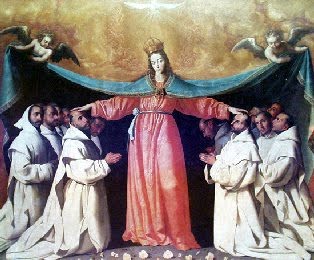
We have already seen what help Mary, as dispenser of divine grace, brings to the support of our fallen nature, and how we, God’s creatures, can lean on her, as it were on His own Arm. But Mary’s love, as a Mother, finds other ways of assisting us. One of the most precious is the unwearying protection whereby she shields her children, unceasingly harassed as they are by the enemy of souls. She fulfills to perfection the delightful symbol which Jesus used in speaking to the Jews, to express His ever steadfast and watchful love for their unhappy race. As the hen gathers her chickens under her wings, when she sees the kestrel hovering near, so does our heavenly Mother gather her children under her cloak and hide them in her heart, at the approach of evil (cf. Saint Matthew 23:37).

At the dawn of creation, Lucifer the archangel set himself up in opposition to the Mother of God. The trial that was to settle forever the lot of the angelic spirits consisted especially, according to several of the Fathers, in the proposal that God made to these beings – so noble and so beautiful by nature – that they should promise in advance adoration and submission to the Incarnate Word, and reverence and obedience to His Virgin Mother. The chief of the angels refused to render this homage, and hell was for him, and for those who followed his lead, the punishment of their revolt (cf. Saint Luke 10:18).

When, in the fullness of time, God became man, the rebel angels rose in fury against the Person of our Savior, and by their hirelings crucified Him to Whom they had refused their adoration in the highest heaven. Filled with rage at the thought of the glories decreed to this Son of promise (cf. Acts 13:23) and their Master forever, they turned their fury against the other sons of the chosen Woman. They waged unceasing warfare against those children of Mary who bear within them the sign of the redeemed. No one is exempt from this warfare: between the sons of Satan and the children of Mary there is irreconcilable enmity (cf. Genesis 3:15). Who will be our support in this struggle? We are so weak when left to our own resources.

“Sinners as we are,” wrote Dom Louis Rouvier, “we are exposed to violent and repeated temptations. The more we have sinned, the more power Satan has over us; and, as the implacable enemy of our souls, he has no greater wish than to see us one day share in his torments. To that end, he exercises all his infernal malice in order to encompass our ruin. How can we escape from his wiles without powerful aid? Ever since Mary crushed the head of the accursed serpent beneath her feet, she has, it is certain, a command over him in virtue of which she is able to free her children from danger. This is why she has been given the consoling title of Auxilium Christianorum – Help of Christians. But can we expect her to use her power on our behalf if we do not call on her? How profitable, then, is it for us to invoke this great Queen frequently, in order to triumph over the temptations of the devil” (Dom Louis Rouvier, Novenas for the Festivals of the Blessed Virgin Mary).

And Mary protects us by renewing our courage. Little by little, she will weaken those evil inclinations left in our nature by sin, those instincts which are stepping-stones to further sin. Above all, she will curb the audacity of our enemies. They cannot endure her presence, and the mere indication of her name puts them to flight. “The powers of darkness,” says Saint Bonaventure, “melt away like wax in the warmth of the fire, when they meet anyone who keeps Mary in remembrance and is in the habit of calling on her, an is zealous in imitating her.”

But should we unhappily presume on our liberty to tear ourselves for a moment from her arms and stretch out our hands to Satan, our heavenly Mother would still come to our aid, by preventing this cruel tyrant from exercising over us the power into which our fault has betrayed us, and by forcing him to give us time to gain our pardon.

In a touching allegory, Holy Scripture describes this manifestation of Mary’s mercy. The sons of Respha had been delivered up to the Gabaonites, who crucified them. By their bodies, keeping untiring watch to defend their remains from the birds of the air by day and from the beasts of the field by night, was their mother. Nor did she leave them until the king, David, had them taken down from the cross, and had them buried with the bones of Saul and Jonathan his son (cf. 2 Kings [2 Samuel] 21:13). Such is the image of Mary, watching over fallen souls, in order to prevent hell from completing the work of their destruction, and ceaselessly drawing down upon them the cleansing waters of sorrow and repentance: donec stilleret eos aqua de cælo. . . until there fall upon them dew from heaven (cf. Psalm 71 [72]:6; Joel 3:18; Amos 9:13).

04 March 2010

"Incline your hearts to the Lord" (Joshua 24:23)

In today’s Epistle, the Lord speaks through the prophet Jeremiah, saying: “Blessed be the man that trusts in the Lord, and the Lord shall be his confidence. And he shall be as a tree that is planted by the waters, that spreads out its roots towards moisture; and it shall not fear when the heat comes. And the leaf thereof shall be green, and in the time of drought it shall not be solicitous, neither shall it cease at any time to bring forth fruit” (Jeremiah 17:7-8).

Similar words are given to us by the Holy Spirit through the psalmist: “And he shall be like a tree which is planted near the running waters, which shall bring forth its fruit, in due season. And his leaf shall not fall off; and all whatsoever he shall do shall prosper” (Psalm 1:3). And he shall be like this fruitful tree because he avoids the occasion of sin and “his will is in the law of the Lord, and on His law he shall meditate day and night” (Psalm 1:2).

Back to today’s Epistle, our Lord says: “I am the Lord Who search the heart and prove the reins: Who gives to every one according to his way, and according to the fruit of his devices” (Jeremiah 17:10). When Samuel was sent to Bethlehem to find the Lord’s chosen king, God said to Samuel: “Look not on his countenance, nor on the height of his stature, because I have rejected him, nor do I judge according to the look of man, for man sees those things that appear, but the Lord beholds the heart” (1 Kings [1 Samuel] 16:7). And Jesus said: “For where your treasure is, there will your heart be also” (Saint Luke 12:34).

All this fits well into the season of Lent and the call of the Lord through the prophet Joel: “Be converted to Me with all your heart, in fasting and in weeping and in mourning. And rend your hearts and not your garments, and turn to the Lord your God” (Joel 2:12-13). Lent is the recognition that the human heart is not always focused on the Lord, is not always right with the Lord; that there are plenty of times which, although “strangers and pilgrims” (1 Saint Peter 2:11), sometimes this foreign land can be all too enticing. But by turning to the Lord, looking “not at the things which are seen, but at the things which are not seen; for the things which are seen are temporal, but the things which are not seen are eternal” (2 Corinthians 4:18), awaiting good and faithful servants is the reward of entering into the joy of the Lord (cf. Saint Matthew 25:21), and no longer being strangers and foreigners, but fellow citizens with the saints (cf. Ephesians 2:19). This is the reward which guarantees eternal prospering!

May our Blessed Lady, who keeps all things of Jesus in her Immaculate Heart (cf. Saint Luke 2:19), lay them upon our hearts and help us to keep those “hearts on her strength” (Psalm 47 [48]:14)!

02 March 2010

In the Distance, the Fire (In Lontananza, il Fuoco)

Here’s another reflection from the Museo della Certosa’s Italian publication, titled: “I Colori del Silenzio.”

Neither saints, nor supermen, the Carthusians,
but sinners, seeking His Face, inflamed by God.
Their poverty? A bond which they draw upon the world
the Father’s mercy.

Their existence? A channel of grace, by grace, for everyone.
Carried by the Church, they carry her without delay in the raised arms
of their prayer,
and the world with her.

They carry you in their hearts.
We are close to you.
No, intimacy with Love doesn’t close in oneself,
but opens up the spirit, enlarges the heart to embrace the whole universe,
every creature.

In the distance, shines the gate fire that consumes: Love!
And love is a brazier…
To answer the call of the Beloved, the sons of Bruno left the world.
But they aren’t fugitives of the world.

Separated from all, they are united to all,
in the deepness intensely.
They reach you in the invisible.
They suffer your sufferings. They hope for your expectations.

Nothing human is left foreign to them.
They offer for you their own lives.
For you, their trials.
They participate in Christ to the great redemption’s work.
Brethren of every creature…

Towards the transfiguration of Love,
in the joy of the Spirit, is ordered the whole life of Bruno’s children.
Listen, listen,
in a world that leaves God, they declare in silence:
“The thirst of happiness that steps across you all, only He may quench it!”

In silence they proclaim:
“God is only Love, Love, Love,
source of every love!
Such a great Love as to be able of filling up completely a heart!
Such a great Love, that only to Him it is possible to offer lives forever.
Ever!”

In a world slave of profit and efficiency,
they choose to abstain themselves from any visible activity.
It’s for chanting You better, immensity of Goodness!
So as to praise You better, Gratitude of Love, and Your Centrality!
Yes, outwardly we’ve chosen to part ourselves from you,
but so as to run towards Love,
carried by the Spirit and carrying you with us,
to illuminate you with the light of the Risen,
to warm you up in the Father’s arms.

There they are, close to you, the children of Bruno: little witnesses of Love.

01 March 2010

Thy Desolate Sanctuary

Today in the Extraordinary Form of the Holy Sacrifice of the Mass, the Epistle is taken from the Book of Daniel (9:15-19). In it the prophet Daniel, while at prayer to Almighty God, says: “Show Thy Face upon Thy sanctuary which is desolate.” Daniel, a prophet, and considering what is contained within the Book that bears his name, one would have to conclude that he was also a visionary.

What did the Lord lay upon Daniel’s heart as he spoke these words? What did Almighty God show him in his spirit? Could he have possibly envisioned the Messiah, the Institution of the Eucharist, and His Crucifixion, and what we all experience on Holy Thursday night when our Eucharistic Lord is removed from the Sanctuary?

This is always a moment in the Sacred Triduum when a deep sadness, and an uncomfortable emptiness hits one’s soul. If there’s ever a doubt about the Real Presence, Holy Thursday night can certainly cure those doubts, when Jesus is removed from the Tabernacle, from the Sanctuary, and suddenly the worship space just feels like a mere building.

Certainly for the Most Holy Mother of Jesus, His apostles and all His followers, that was a time of great fear, anxiety, uncertainty and emptiness; and so it should be for us. Quite possibly our Blessed Mother knew that the Crucifixion and death of her Son wasn’t the end, but even if she did know, it surely doesn’t make witnessing His suffering and Crucifixion any easier, as indicated by her title of “The Mother of Sorrows.”

On Holy Thursday, we begin to anticipate the great Victor, Jesus Christ, on Easter Sunday rising from the dead. Why do many of us, then, go through a period of this feeling of emptiness when Jesus is removed from the Sanctuary? Perhaps it is a brand of compunction that God infused in our souls. The prophet Daniel said something else in his prayer that is also most interesting: “For by reason of our sins and the iniquities of our fathers…” That is a heaping dose of reality: our Tabernacles and Sanctuaries are empty beginning on Holy Thursday night because we are sinners, and Jesus, consequently, had to pay the ultimate price for our sins.

Our Lord through the prophet Joel sets the tone for us at the beginning of Lent on Ash Wednesday: “Be converted to Me with all your heart, in fasting, and in weeping, and in mourning. And rend your hearts, and not your garments, and turn to the Lord your God: for He is gracious and merciful, patient and rich in mercy” (Joel 2:12-13). That is our God, Who is Love, calling to those whom He loves, asking them to take the season of Lent seriously. Man fell from grace and God’s justice was sentenced to the Man Jesus Christ, for the sins of us all. And now our God calls us to repentance, that He may exercise His mercy. And when Jesus rises from the dead on Easter morn, most especially, our gratitude is called for. Jesus, the Second Person of the Blessed Trinity, defeated death; He overcame the darkness with His marvelous Light – for us all.

“Jesus, Master, have mercy on us” (Luke 17:13). This is the plea of ten lepers. They were mercifully made clean by Jesus but of the ten only one Samaritan returned to Jesus to offer thanks. Jesus said: “Were not ten made clean? And where are the nine? There is no one found to return and give glory to God, but this stranger” (Luke 17:17-18). May we all be strangers, by meditating on the Passion of our Lord Jesus Christ, and by unceasingly offering gratitude to God for His mercy, which ultimately rewards us the unfathomable gift of eternal life with Him.