10 May 2011

Auxilium Christianorum

Sinners as we are, we are exposed to violent and repeated temptations. The more we have sinned, the more power Satan has over us; and as the implacable enemy of our souls, he has no greater wish than to see us one day share in his torments.

To that end , he exercises all his infernal malice in order to encompass our ruin. How can we escape from his wiles without powerful aid?

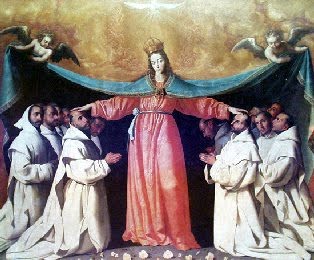
Ever since Mary crushed the proud head of the accursed serpent beneath her feet, she has, it is certain, a command over him in virtue of which she is able to free her children from danger. This is why she has been given the consoling title of Auxilium Christianorum – Help of Christians.

But can we expect her to use her power on our behalf if we do not call on her? How profitable, then, it is for us to invoke this great Queen frequently, in order to triumph over the temptations of the devil.

~ Dom Louis Rouvier: Novena for Festivals of the Blessed Virgin Mary ~

09 May 2011

Blessed Niccolò Albergati

Born in 1375 in Bologna, Italy; it appeared that Niccolò Albergati was going to have a career in Law. He received his Law degrees in Bologna but Divine Providence had other plans for Niccolò. While visiting the Carthusian Charterhouse in Bologna, a storm prevented him from leaving. Because of his delayed departure he decided to sit in on the hour of Matins. This liturgical hour along with Lauds and Vespers are the three hours from the Divine Office which the Carthusians pray in community, except on Sundays and Solemnities when all the hours, except Prime, are prayed in community. Otherwise, all other hours normally are prayed by the monks in the solitude of their cells.

The soon to be a lawyer, Niccolò Albergati, however, became absorbed by the monks' singing of Matins and he was so impressed that he asked if he could stay and enter the community. He made his profession and would be ordained into the priesthood. He was an excellent monk and in 1407 was elected as Prior after twelve years of residing with the Bologna community.

Ten years later came the news that no Carthusian likely wants to hear. Bologna was in need of a bishop and Niccolò was elected by the city magistrates. He did, however, turn it down stating that he would only accept the episcopate if the Reverend Father of the Carthusian Order told him to do so. The Reverend Father of the Order at that time was Dom John Griffenberg who consulted the community at Bologna which felt that Dom Niccolò would be a worthy bishop. Thus he became the Bishop of Bologna but never abandoned his monastic lifestyle even though he was no longer in the cloister. He continued to wear his habit along with the hair shirt and remained faithful to the fasts and abstinences of the Carthusian Order.

In his spiritual life, he was said to have an exemplary interior life and would spend long nights in prayer. The Carthusian Order refers to Blessed Niccolò as a true son of Saint Bruno.

His life as bishop would eventually expand beyond Bologna as two popes would require his service. In 1426 he was made a cardinal. His titular Church was Santa Croce in Rome.

His life in the hierarchy of the Roman Catholic Church was certainly more visible than most Carthusians would ever experience but Blessed Niccolò never lost his simplicity and humility.

A very trying time in his life would have Niccolò fleeing Bologna and taking refuge with the Carthusians in Florence. The people of Bologna rebelled against him and it was something they would eventually repent of which at the insistence of Pope Eugene IV, returned Niccolò to his duties in the diocese of Bologna.

He died on May 9, 1443 in Siena while accompanying the pope on diplomatic business.

Certainly what we can learn from Blessed Niccolò Albergati is the need and the will to remain faithful to our spiritual life and our commitment of service to the Lord while still having other cares and duties in the world.

Blessed Niccolò Albergati, pray for us!

07 May 2011

Dominica Tertia Paschæ

First Reading, Acts 2:14, 22-33
Saint Peter in this Reading is exercising his office as the Supreme Pontiff. The Gospel verse, "He who hears you, hears Me" (Lc 10, 16) comes to mind here. It's tempting to think that the tone of Peter's voice is quite stern. Here's something to consider, however: The apostle Peter we've grown accustomed to from the Gospels is quite different from the Holy Father Peter heard in this Reading. Peter speaks here with authoritative confidence -- the same confidence which always flowed from our Lord Jesus Christ. Obviously Peter has been given the graces needed to carry out his appointment as the Vicar of Christ, and so by now, after being an apostle of Jesus, learning His teachings, seeing His miracles and having witnessed His Resurrection, there is evidence that Peter has spiritually matured to a lofty degree. Thus it might be a mistake to assume that when Peter "raised his voice" it means that he was harsh. Most likely he "raised his voice" only to be heard. An elevated level of Christian spiritual maturity usually means that one conducts themselves with the compassion and mercy of Christ – although it cannot be ignored that some saints were known to have a short fuse. Most likely Peter's tone is one of heartfelt tenderness even with his use of the blunt words, "you killed" since Peter himself is quite aware of his own thrice denial of Jesus. The more that one is exposed to the Light of Christ, the higher awareness one has of their own sinfulness. The saints were most grateful for that, which is why all of them were very faithful to the Sacrament of our Lord's mercy. Thus Peter knows he has traveled a long, difficult road to reach the point of what intimates to be an exalted spirituality. An important theme in Peter's speech is a bit subdued and could be missed if reflection doesn't accompany the perusing of Peter's address. That theme is -- what has happened to Jesus, from brutality to glory, was a divine plan. Peter says that with the words "set plan and foreknowledge of God" but they are somewhat overshadowed by the words "you killed, using lawless men." But now Peter and the other apostles stand before us as witnesses to Christ's Resurrection. Concerning the Resurrection of our Lord, Peter first points out that David had prophesied it and quotes the king's words from Psalm (15) 16. After quoting David, Peter then proclaims that he and the others are eyewitnesses to the fulfillment of King David's prophecy. Another subtle hint that Peter's speech is one of commiserative fellowship rather than angry judge is his use of the affectionate term, "My brothers." At the Vatican web site you'll find that most public addresses made by popes began with the words: "Dear Brothers and Sisters." There's something both ordinary and extraordinary about these words. First, they are an acknowledgement from these men of God that we are all brothers and sisters in the Lord. But also, when these words come specifically from the Vicar of Christ, we also hear Jesus speaking through them and thus it is the Lord Himself saying to us: "You are My brothers and sisters." Peter proclaimed that it was impossible for Christ to be held by death and that is prophesied here by David; but another side to David's prophecy is to understand that Israel's king is also referring to himself and all humanity. Because of Christ, death no longer can hold us as we are called from death to the paths of life, to be filled with joy in our Lord's presence forever.

Second Reading, 1 Peter 1:17-21
Like the First Reading, it is Saint Peter who addresses us; and what he has to say here might seem obvious but it's not terribly difficult to become weighed down by life and all its concerns and thus turn the focus away from God. Basically what Peter says here is that if you address God as Father, then conduct yourself like you are His child. Let your appreciation of the fact that you have been ransomed with the Blood of Christ be evidenced by your actions. Reverence is exemplified early on in scripture when God commands Moses to remove his sandals because he was standing on holy ground (cf Ex 3, 5). Jesus showed reverence to His heavenly Father by falling flat on the ground to pray in the Garden of Gethsemane (cf Mc 14, 35). Saints Vincent Ferrer, Vincent de Paul, Francis de Sales, Jean-Marie Vianney and others prayed the Divine Office on their knees. Many who were privileged to attend a private Mass of Pope John Paul II testified that upon entering the pope's private chapel, they would find the Holy Father kneeling before the Tabernacle immersed in deep prayer. And it has been said that Pope Pius IX prayed the entire Divine Office kneeling without any support. These examples of reverence were realizations in the lives of these servants of the Servant that we have been ransomed with His precious Blood. In part, our love for God is expressed by how quickly we repent and reconcile ourselves to our Lord when we fall. It was Archbishop Timothy Dolan of the Archdiocese of New York who once said that to truly mean it when you say, "I love you, Lord" -- the words, "I'm sorry" must immediately follow.

Gospel, Luke 24:13-35
It's not clear if these two men were prevented from recognizing Jesus because our Lord purposely made Himself appear different or if it is because His glorified Body has vastly different features. But since our Lord is not recognized until the breaking of the bread, it would seem that our Redeemer has something to say to all of us. "Jesus drew near and walked with them." This is not all that different from our own experiences in life. If Christ dwells within us, then He is close to us in every person we meet; but like these two men, we often fail to recognize Him in that person -- and in ourselves. No one knows for certain who Cleopas is; Saint Jerome thought him to be a citizen of Emmaus who invited Jesus to stay with him at his house. Saint Jerome also testified that during his day there was a church that existed which was originally thought to be the house of Cleopas. Origen, one of the writers of the early Church, thought Cleopas to be Simon Peter. Other speculations include: the brother of Saint Joseph, or Saint Luke the writer of this Gospel story, or the father of Saint James the Less. Jesus interpreted to them all that was in the Scriptures concerning Him. This must've taken a great deal of time but what a tremendous blessing for these two men to have been given a bible lesson by Jesus Christ Himself. Jesus, however, does say to them beforehand: "Oh, how foolish you are!" The lesson for us in that statement is to familiarize ourselves with Sacred Scripture and learn what the prophets say of Him and how those prophecies were fulfilled by Him in the New Testament. Understanding the Old Testament really makes the New Testament come to life. Through the comprehension of Scripture we are able to welcome Jesus Christ into our lives based on what is preordained by divine decree and not by something our imaginations conjure up. The "breaking of bread" was a popular term for the Eucharist during the apostolic times. It cannot be ignored that our Lord is demonstrating something that is strikingly similar to the liturgy: First, there is the breaking open of the Scriptures – the Liturgy of the Word – an explanation of the scriptures follows – the homily – and then the breaking of the bread – the Liturgy of the Eucharist. This Gospel should be an eye opening experience for Catholic Christians who only acknowledge Jesus in their lives for one hour a week. If there is no daily prayer life of any kind, that is, meditation, reflection, spiritual reading or daily reading of scripture, then Jesus will pass by every day and probably will not be recognized. It is only during the breaking of Bread at Sunday Mass that He will be recognized, albeit under the guise of bread and wine. Jesus shows up in our lives every day and takes on many different forms: Sometimes He is the cause of our ability to be in the right place at the right time; sometimes He is the delay that takes us off our schedule because being on schedule would place us right in the middle of an unfortunate circumstance; other times He is found in others who lend a helping hand; and at other times He is even that person who plucks your last nerve especially when having a tendency to be overly impatient. On Sundays we're all standing in line to receive the Eucharist because it is there at Mass that we most recognize our Lord, and it is at Mass that He feeds our souls with His Body and Blood. But Jesus speaks to us daily and He calls us to reflect daily where He works and moves in our lives. If we can identify our Lord under the veil of ordinary bread and wine, then through daily prayer, sacred reading and meditation certainly His Holy Spirit can be detected in other persons, places or things that are a part of our everyday experience, as well as seeing Him within ourselves.

05 May 2011

Standing Near the Promised Reward of God

This brief reflection from Saint Cyprian turned my thoughts toward Blessed John Paul II and the example of his life.

This temporal and brief suffering, how shall it be exchanged for the reward of a bright and eternal honour, when, according to the word of the blessed apostle, 'the Lord shall change the body of our humiliation, that it may be fashioned like to the body of His brightness!' What now must be the vigour, beloved brethren, of your victorious consciousness, what loftiness of your mind, what exultation in feeling, what triumph in your breast, that every one of you stands near to the promised reward of God, are secure from the judgment of God, walk in the mines with a body captive indeed, but with a heart reigning, that you know Christ is present with you, rejoicing in the endurance of His servants, who are ascending by His Footsteps and in His paths to the eternal Kingdoms!

You daily expect with joy the saving day of your departure; and already about to withdraw from the world, you are hastening to the rewards of martyrdom, and to the divine homes, to behold after this darkness of the world the purest Light, and to receive a glory greater than all sufferings and conflicts, as the apostle witnesses, and says, 'The sufferings of this present time are not worthy to be compared with the glory that shall be revealed in us'.

04 May 2011

It is enough for me that Jesus is still alive

Today at Matins the Carthusians reflected on these words from Blessed Guerric of Igny:

If you believe in your heart that God raised Jesus from the dead, you will be saved.

Jesus, my God, is still alive! On hearing it my spirit, which was asleep through timidity, has revived. For the joyful voice of this happy message raises even from death those buried deep in sin. Otherwise, if Christ, coming up from hell, left them there in the depths, there would certainly be no hope for them; their fate would be buried in forgetfulness.

By this token you may clearly know that your soul lives again fully in Christ if it echoes this sentiment: ‘It is enough for me that Jesus is still alive’. How faithful and worthy of a friend of Jesus is that voice, how pure that act of love which says: ‘It is enough for me that Jesus is still alive. If He lives, I live, for my spirit acts through His. Yes, He is my life, my All in all. For what can I lack if Jesus is still alive? While everything else may be taken from me, nothing else matters to me so long as He lives. If He wishes then, let Him take no account of me. It is enough for me that He still lives even if He only lives for Himself’.

When the love of Christ so absorbs all a man's affections that, unmindful and forgetful of himself, he has no feeling for anything but Jesus Christ and what pertains to Him then, I say, love has been made perfect in him.

To a man who so loves, poverty is no burden, he feels no hurt, laughs at insults, disdains misfortunes, considers death as a gain. In fact he does not think in terms of death, knowing that he passes from death to life.

03 May 2011

The Church is One

Today is the feast of Saints Philip and James, apostles of Christ. At the hour of Matins the Carthusians heard a piece from Saint Cyprian of Carthage, ‘On the Unity of the Church’, which is always a good topic, especially on the feasts of apostles. Here is what was read:

The Church is one, which is spread abroad far and wide into a multitude by an increase of fruitfulness, as there are many rays of the sun, but one light; and many branches of a tree, but one strength based in its tenacious root; and since from one spring flow many streams, although the multiplicity seems diffused in the liberality of an overflowing abundance, yet the unity is still preserved in the source. Try to separate a ray of the sun from its body of light, its unity does not allow a division of light. Break a branch from a tree -- when broken, it will not be able to bud; cut off the stream from its fountain, and that which is cut off dries up. Thus also the Church, shone over with the light of the Lord, sheds forth her rays over the whole world, yet it is one light which is everywhere diffused, nor is the unity of the body separated. Her fruitful abundance spreads her branches over the whole world. She broadly expands her rivers, liberally flowing, yet her head is one, her source one; and she is one Mother, plentiful in the results of fruitfulness: from her womb we are born, by her milk we are nourished, by her spirit we are animated.

The Bride of Christ cannot be adulterous; she is uncorrupted and pure. She knows one home; she guards with chaste modesty the sanctity of one couch. She keeps us for God. She appoints the sons whom she has born for the Kingdom. Whoever is separated from the Church and is joined to an adulteress, is separated from the promises of the Church; nor can he who forsakes the Church of Christ attain to the rewards of Christ. He is a stranger; he is profane; he is an enemy. He can no longer have God for his Father, who has not the Church for his Mother. If any one could escape who was outside the ark of Noah, then he also may escape who shall be outside of the Church. The Lord warns, saying, ‘He who is not with Me is against Me, and he who gathers not with Me scatters’ (Mt 12, 30). He who breaks the peace and the harmony of Christ does so in opposition to Christ; he who gathers elsewhere than in the Church, scatters the Church of Christ. The Lord says, ‘I and the Father are One’ (Io 10, 30); and again it is written of the Father, and of the Son, and of the Holy Spirit, ‘And these Three are One” (1 Io 5, 7). And does any one believe that this unity which thus comes from the divine strength and is united in heavenly sacraments, can be divided in the Church, and can be separated by the parting asunder of opposing wills? He who does not hold this unity does not hold God’s law, does not hold the faith of the Father and the Son, and is separated from life and salvation.

For the Lord, when He would urge unanimity and peace upon His disciples, said, ‘I say unto you, that if two of you shall agree on earth touching anything that you shall ask, it shall be given you by My Father Who is in heaven. For where two or three are gathered together in My Name, I am with them’; showing that most is given, not to the multitude, but to the unanimity of those that pray. ‘If’’, He says, ‘two of you shall agree on earth’; He placed agreement first; He has made the harmony which comes from peace a prerequisite; He taught that we should agree firmly and faithfully. But how can he agree with any one who does not agree with the body of the Church itself, and with the universal brotherhood? How can two or three be assembled together in Christ’s Name, who, it is evident, are separated from Christ and from His Gospel? For we have not withdrawn from them, but they from us; and since heresies and schisms have risen subsequently, from their establishment for themselves of diverse places of worship, they have forsaken the Head and Source of the truth. But the Lord speaks concerning His Church, and to those also who are in the Church He speaks, that if they are in agreement, if according to what He commanded and admonished, although only two or three gathered together with unanimity should pray -- though they be only two or three -- they may obtain from the Majesty of God what they ask.

God is One, and Christ is One, and His Church is One, and the faith is One, and the people are joined into a substantial unity of body by the cement of harmony. Unity cannot be severed; nor can one body be separated by a division of its structure, nor torn into pieces, nor have its limbs torn. Whatever has proceeded from the womb cannot live and breathe in its detached condition, but loses the substance of health. The Holy Spirit warns us, and says, ‘What man is he that desires to live, and longs for good days? Refrain your tongue from evil, and your lips that they speak no guile. Eschew evil, and do good; seek peace, and ensue it’ (Ps 33, 12). The son of peace ought to seek peace and ensue it. He who knows and loves the bond of charity, ought to refrain his tongue from the evil of dissension. Among His divine commands and salutary teachings, the Lord, when He was now very near to His Passion, added this one, saying, ‘Peace I leave with you, My peace I give unto you’ (Io 14, 27). He gave this to us as a heritage; He promised all the gifts and rewards of which He spoke through the preservation of peace. If we are fellow-heirs with Christ, let us abide in the peace of Christ; if we are sons of God, we ought to be peacemakers. ‘Blessed’, says He, ‘are the peacemakers; for they shall be called the sons of God’ (Mt 5, 9). It benefits the sons of God to be peacemakers, gentle in heart, simple in speech, agreeing in affection, faithfully linked to one another in the bonds of unanimity.

02 May 2011

Pray for Priests: They Speak in Christ's Name

If there be those here present, my dear brethren, who will not believe that grace is effectual within the Church, because it does little outside of it, to them I do not speak: I speak to those who do not narrow their belief to their experience; I speak to those who admit that grace can make human nature what it is not; and such persons, I think, will feel it, not a cause of jealousy and suspicion, but a great gain, a great mercy, that those are sent to preach to them, to receive their confessions, and to advise them, who can sympathize with their sins, even though they have not known them.

Not a temptation, my brethren, can befall you, but what befalls all those who share your nature, though you may have yielded to it, and they may not have yielded. They can understand you, they can anticipate you, they can interpret you, though they have not kept pace with you in your course. They will be tender to you, they will 'instruct you in the spirit of meekness' (cf Gal 6, 1), as the Apostle says, 'considering themselves lest they also be tempted' (ibid).

Come then unto us, all ye that labor and are heavy laden, and ye shall find rest to your souls; come unto us, who now stand to you in Christ’s stead, and who speak in Christ’s Name; for we too, like you, have been saved by Christ’s all-saving Blood. We too, like you, should be lost sinners, unless Christ had had mercy on us, unless His grace had cleansed us, unless His Church had received us, unless His Saints had interceded for us.

Be ye saved, as we have been saved; 'come, listen, all ye that fear God, and we will tell you what He hath done for our souls' (cf Ps 65 [66], 16). Listen to our testimony; behold our joy of heart, and increase it by partaking in it yourselves. Choose that good part which we have chosen; join ye yourselves to our company; it will never repent you, take our word for it, who have a right to speak, it will never repent you to have sought pardon and peace from the Catholic Church; it will never repent you, though you go through trouble, though you have to give up much for her sake. It will never repent you, to have passed from the shadows of sense and time, and the deceptions of human feeling and false reason, to the glorious liberty of the sons of God.

And O, my brethren, when you have taken the great step, and stand in your blessed lot, as sinners reconciled to the Father you had offended, O then forget not those who have been the ministers of your reconciliation; and as they now pray you to make your peace with God, so do you, when reconciled, pray for them, that they may gain the great gift of perseverance, that they may continue to stand in the grace in which they trust they stand now, even till the hour of death, lest, perchance, after they have preached to others, they themselves become reprobate.

~ Blessed John Henry Newman ~