22 November 2010

The Fullness of the Life of Christ Within Us

Transforming Union or possessing the fullness of Christ is something most of us will never experience in this lifetime. But certainly we’re familiar with stories of saints and mystics who have been there. But what is this transforming union? Why do so few experience it? Is it available to everyone? A Carthusian writer tackles this subject.

‘My Beloved is mine, and I am His’ (Song of Songs 2:16).

Transforming union is the full development on earth of sanctifying grace, that is, the fullness of the life of Christ within us. Sadly, it is a state which is rarely reached, for it implies a plenitude of love. But, however far we may be from that state, we should know something about it, so as to be able to distinguish what is only transitory in the spiritual life, from that which pertains to its perfection.

There is one last trial, a testing of love, in which the soul, intensely drawn to the One it loves, aspires with its whole being to heavenly union. It is the desire to die, to break the chains of this life. If the Lord inspires this desire in the soul, it is in order to fulfil it, but in an unexpected way, by giving the grace of transforming union.

Sanctifying grace is the free gift of alliance contracted by God with each one of us, in the Church. It consists in the gift of the Holy Spirit Who communicates divine life to us: the knowledge and love which enable us to know and love God in an intimate exchange of personal friendship. He says to each of us, ‘I am calling you and you are My friend’. And His Creator Word establishes us in a sort of equality with Him, of friend to Friend (or, in other words, makes us share in the divine nature). The life of prayer is all about learning to live this friendship. We have to be gradually raised to this dignity, purified, and slowly transformed, until our will is one with the will of the Lord and our heart belongs totally to Him. Love is at the heart of transforming union, it is the substance of it. The phenomena which usually manifest this state are secondary, and in some cases are quite hidden, or even absent.

The life of grace becomes conscious. God is experienced not only as the objects of our acts of faith, hope and love, but as the interior source, the indwelling co-principle, of these acts. The sap of divine life flows in our faculties.

The term ‘spiritual marriage’ is sometimes used to indicate this fusion of two lives: an intimate and stable union, based on the total, mutual gift of love between two persons, a gift with implications of rights and duties. ‘All that is Mine is yours, and all that is yours is Mine’ (Saint John 17:10).

The soul shares in the knowledge of God. It is given a mysterious knowledge, both luminous and obscure, by the love poured into it by the Holy Spirit. Love is itself a form of knowledge that goes further than any knowledge that can be formulated in images or ideas. It plunges into the infinite reality of divine life. The Spirit is the flame of love in the soul, a brightly burning flame.

There is no longer any distance. God communicates Himself to the soul by substantial touches, that is, directly, substance to substance, without passing by the faculties. Plunged into the divine fire, the soul becomes fire. Immersed in the vast sea, the drop of water becomes sea. Traversed by light, the pane of glass becomes light, without however ceasing to be what it is. No image can adequately express the reality. The saints and great mystics of all times have tried to speak of it, but this irruption of infinite life into the tiny space of a human soul is beyond words; do we not however, each one of us, recognize in this, in some obscure way, our deepest desire? How strange. But not so strange really, for our heart is made for You, Lord.

This union is the source of special insights on God and on the mysteries of the faith: sparks from the furnace at the centre, that the intelligence receives by way of intuitive knowledge. The faculties no longer operate in their usual way, which is more or less discursive, but in the mode of the Holy Spirit acting through the gifts of intelligence and wisdom.

In this state, there is an habitual vision of the presence of God in the centre of the soul, which is perceived, without mediation, as the dwelling of God. The higher faculties are drawn passively and imperiously towards the deep centre of the soul where God dwells. They are plunged into this source of life, and emerge from it transformed, to act at the exterior. The activity of the soul flows from this deep centre, the initiative comes from the interior and not from outside, from the Spirit and not from the world. This is why it is so important for the person of prayer to be able to enter into the interior depths of his or her soul, to remain there habitually, and to act from that centre.

The soul often possesses habitually, but with differing degrees of intensity, the vision of the Holy Trinity, or of the divine nature. This is the highest point of spiritual illumination, but paradoxically is sometimes called ‘the Great Darkness’, for in drawing nearer, God reveals Himself to be supreme mystery, and totally different.

Whether this vision concerns the divine Persons or their unique nature, seems to depend on the religious sensitivity of the soul and the path followed. There is an Eastern tradition particularly directed towards experience of the divine nature, without however excluding, or regarding as secondary, loving intimacy with the Persons of the Holy Trinity. But at this level of mystical experience, however necessary the concepts of nature and person may be, they are very inadequate with regard to the incandescent reality of the union of God.

The Holy Spirit is in charge of the whole of this transformation. It is the Spirit Who acts in us as the principle of our sanctification. He inclines the soul to these supernatural acts, not by passing through the faculties, from outside, but from inside, from His dwelling in the centre, in the substance of the soul. Thus the Spirit moves the faculties, but in His own particular way, enabling them to attain their objects directly with an assurance and strength beyond their normal possibilities. Paradoxically, there is great liberty in this, for the soul is not moved like a lifeless puppet, but as someone who is free. This is a great mystery. The spiritual acts flow freely from a person transformed in his very substance by the Spirit; and these acts express perfectly the most intimate depths of that person, there where he adheres to God so closely that, with God, he is spirit, and source of life (cf. 1 Corinthians 6:17).

It is easy to say words that mean nothing, or say too much. It has been suggested – and by the mystics sometimes – that the soul breathes the Spirit with the Father and the Son; that it creates the world; that, placed within God’s creative act, it is maintaining all things; that, in a game of love, it gives God to God, since God in all truth has given Himself to the soul… All this is true, but in a sense that in no way diminishes the infinite transcendence of the Lord which is radically beyond our grasp. What is clear is that, by grace, in transforming union, the soul is plunged into a life that is infinitely beyond anything that we can possibly imagine. The fine shell of its little personality becomes perfectly transparent to the marvellous light in which it bathes. The soul is known and it knows. It is loved and it loves: perfectly, beyond anything we can possibly imagine or hope for.

And all of us, with unveiled faces, seeing the glory of the Lord as though reflected in a mirror, are being transformed into the same image from one degree of glory to another; for this comes from the Lord, the Spirit (cf. 2 Corinthians 3:18).

We set off to seek God, following in the steps of Jesus, on the path of the beatitudes of poverty and purity of heart, by the way of the cross and love, towards the Father. Now at the end, we find Christ again, but the risen Christ. The extraordinary phenomena of the mystical life are an irruption in our world of the life of the resurrection, rays of light from Mount Tabor. If we can come to the Father in all confidence, as sons, it is because of the grace of Christ communicated to us through the Spirit. We are taken up into the life of Christ, we become as it were one person with Him, to constitute what Augustine called ‘the total Christ’. ‘It is no longer I who live, but it is Christ Who lives in me’ (Galatians 2:20).

When the Word became flesh, He did not eliminate human nature, but raised it, rather, to the fullness of its liberty and perfection; and in the same way, when divine life takes flesh, so to speak, in us – not hypostatically, but by union of grace – our humanity is not eliminated, but radically transformed. It is really our own self that is transformed; myself, with my own features, my character, my feelings, my personal history, my wounds, my limits, my sufferings, my sensitivity… Christ in His glory bears the marks of the nails. The glory He communicates to us is the glory of humanity redeemed, and is all the more luminous because of that. The bread that we offer to be consecrated is the bread of our whole nature. That is why the Eucharist is so important: for there, the Body and Blood of Christ, the living humanity of Christ, touches us, penetrates us, in order to transform us into Himself.

The spiritual person does not become an angel, he or she becomes Christ. And just as so few were able to recognize God in Jesus, so we too often pass by the saints. We look out for the extraordinary and the spectacular, and all we find is something marvellously human, a humanity that is in the likeness of God.

Generally there are not many extraordinary sensory phenomena, and hardly any more ecstasies. The human nature of the mystic is now used to God’s action, and has adapted to it. On the level of the senses, there is no resistance, and the higher faculties have been strengthened in their usual mode of activity.

We are so concerned with the outward show of sanctity, with appearances! Yet the whole life of a monk, and especially of the solitary monk, is on the level of being, where all show is ridiculous comedy. The ‘little’ Thérèse said once: ‘There is no need for appearances, as long as the reality is there. Our Lord died of love on the Cross, and yet look at His agony’.

And all is humility, because humility is born of truth. In this ultimate intimacy with the Lord, the monk knows, he experiences, that all is grace, that all comes from God. He takes stock in his own minute little self in the shadow of the greatness of God, the greatness of infinite Love. He makes no effort to be humble. We do not need light to see daylight.

In the mystic, the struggle between attention to God and contact with the world no longer exists. Throughout the whole development of the life of prayer, we have seen a ligature of the powers of the soul, from the partial withdrawal from the world in the prayer of quietude, up to the point of ecstasy, when all its usual activity in relation to the surrounding world becomes impossible: it has to be Martha or Mary. But from now on, we find Martha and Mary living together in harmony. Interior union with God is not hindered by the activity of Martha, and vice versa.

There are two levels of conscience, simultaneously occupied each with its own object, natural or supernatural, without hampering one another. This is the secret of the activity of the great saints, which is so fruitful spiritually: it flows from the source, without leaving it. Everything in the saints is unity, and they have tremendous strength to act – if God calls them to do so – and to suffer.

The soul is not exempt from temptations and trials, which are usually of short duration; but it is not deeply affected by them. The great peace in the depths of the heart is not troubled, even when the surface is tossed by the storm. ‘My peace I leave with you’ (Saint John 14:27).

Let us not forget that, except for a few moments on Mount Tabor, Christ offered us the humble, hidden image of the Servant. He renounced, precisely, the outward show of glory that so attracts our ambivalent desires. The light of a soul transformed by grace often dwells in a humanity which seems quite ordinary, sometimes even in one that is heavily burdened, always in one that is simple. Christian perfection does not lie in the Greek ideal of an earthly fulfilment of all one’s human potential; its aim is the plenitude of charity, which, in a world marked by sin, can take the form of sacrifice and suffering assumed in a consent of faith, and of which the fulfilment is on the other side of death, in eternal life.

20 November 2010

Domini Nostri Iesu Christi, Universorum Regis

First Reading, 2 Samuel 5:1-3
The Solemnity of Christ the King was instituted in 1925 by Pope Pius XI in his encyclical Quas Primas. It was originally celebrated on the last Sunday of October, immediately preceding the Solemnity of All Saints. The revision of the liturgical calendar placed it at the final Sunday in Ordinary Time. In this First Reading we read about the crowning of David as king of Israel. He was God's choice. And it is from his lineage that the Messiah would come. In Saint Matthew's Gospel, Jesus Christ is listed as ‘the son of David, the son of Abraham’ (Saint Matthew 1:1). David's kingship has its limitations as he is crowned to be the shepherd and commander of Israel. Jesus Christ's Crown is not a result of victory over flesh and blood, but of victory over the mystery of evil which seeks the ruination of souls. In an incredible act of love God became Man to redeem sinful humanity; and because of our sinful ways, all we could do was crown Him with thorns. Christ's love is not only beyond the means of human expression, but also logically it doesn't make sense: the God-Man Who was crowned with thorns is offering us who continue to crown Him with thorns by our sins, eternal glory. As our Lord says: ‘My thoughts are not your thoughts; nor your ways My ways’ (Isaiah 55:8).

Second Reading, Colossians 1:12-20
In this Reading there is a spirit of gratitude to Almighty God for the gift of salvation through Jesus Christ. The ‘holy ones in light’ represents all the supernatural benefits of salvation including God Himself Who is the Source of all benefits. God the Father has delivered us from the adversary and transferred us to the perfect, well-ordered Kingdom of His beloved Son. We have been liberated from a state of guilt. Jesus ‘is the Image of the invisible God’. The Catechism of the Catholic Church reads: ‘By His revelation, the invisible God, from the fullness of His love, addresses men as His friends, and moves among them, in order to invite and receive them into His own company’ (CCC 142). Saint Thomas Aquinas relates ‘image’ with ‘prototype’ and says that image has three qualities at the same time:
It must have a likeness with the original prototype.
It must be derived from the prototype.
It must belong to the same species as the prototype.
This explanation of ‘image’ delineates that mere likeness alone would not be sufficient. A photograph, for example, is a likeness but it is not an image in the sense that is applied here. By Saint Paul writing that Jesus is the Image of the invisible God, he most certainly means God the Father. Therefore, Christ is the Image of God the Father because He exemplifies the Father. Saint John Damascene explains that image in itself does not demand equality with the original model, but we know that Christ, the Image, is identical and equal to the Father in every way. The only difference is that Jesus is begotten. Saint Paul continues this letter by writing that Christ is ‘the firstborn of all creation’. This is not a reference to being born of the Virgin Mary. Paul's meaning is that Jesus was before all creatures, proceeding from all eternity from the Father. Firstborn, then, as it is applied here is a metaphor for pre-existence before creation. Christ is Supreme, eternal and the final revelation of God because ‘all things were created through Him and for Him’. He is the reason and cause of all things and yet as our Creator He does not distance Himself from us, but instead, He wishes to have communion with us by means of His boundless love. Christ is ‘Head of the Body, the Church’, and yet His Sovereignty over the members does not deter Him from a close and intense union with them. He is ‘the firstborn from the dead’ in the sense that He is the first to rise to a New Life and in His glorious Triumph He is the cause of our resurrection. ‘For in Him all the fullness was pleased to dwell’. Generally, ‘fullness’ is synonymous with ‘totality’. In this case, however, ‘all the fullness’ more appropriately means ‘all existence’. Being reconciled to God through Christ with those on earth primarily means the human race; but what does Paul mean by reconciliation with those in heaven? Saint John Chrysostom defines those in heaven as angels. This doesn't mean, however, that Christ sacrificed Himself for angels. Angels are totally and unequivocally devoted to the cause and glory of Almighty God. This suggests, then, that before Christ's redeeming Sacrifice, the angels were at enmity with the human race because our sins separated us from God. Christ put an end to this division by restoring us to God's favour ‘through the Blood of His Cross’.

Gospel, Saint Luke 23:35-43
The Solemnity of Christ the King kicks off the final week of Ordinary Time; and perhaps this scene in the Gospel might remind you more of Holy Week than the celebration of Jesus Christ as King. But that's just it! Christ is no ordinary King. It is usually the king's loyal subjects who are dying on the battlefield to save the life of the king. Here, the King is dying for the life of His subjects, who just happen to be sinners and therefore not all that loyal. In the biblical days, mockery aimed at the king could very well mean death for the mocker. Here, mockery is aimed at the King with statements like: ‘He saved others, let Him save Himself if He is the chosen One, the Christ of God’ - and – ‘If You are King of the Jews, save Yourself’. In this case, not only will the mockers not be executed, but the King is being executed to save the lives of those who are like these mockers - in other words, sinners. Could Christ have come down from the Cross? Absolutely! Then why didn't He? It was not the nails that held Him to the Cross. Rather, it was His love for humanity collectively and His love for each and every one of us individually. He sacrificed Himself to defeat an enemy that we, left to ourselves, would never be able to overcome - death. Earthly kings have servants; our heavenly King, however, was a Servant. Earthly kings sit on a throne in all their glory - that is until they are overtaken or deceased. Our heavenly King also sits on a Throne, but in eternal glory; and what really makes our heavenly King so special beyond human logic is that He has secured eternal glory for His people, sinners that we are. It seems fitting to reiterate what was written in the First Reading's commentary: ‘My thoughts are not your thoughts; nor your ways My ways’ (Isaiah 55:8). Who really understands this immeasurable love freely given by Love Himself? A wonderful sense of hope is given to us in this Gospel because Jesus promises Paradise to the repentant criminal. Something else in this scene could also leave one with a sense of hope which perhaps isn't as strong as the former but nevertheless does shed at the very least a dimmer ray of hope. The repentant criminal reminds the reviling criminal – and really all of us - of the condemnation we could be subject to. What does the reviling criminal see when he looks at Jesus after hearing that promise of Paradise given to the repentant criminal? Does He see that Divine Love which cannot be explained by mere words? Does He see hope for himself even after he tempted God? What we do know is that Jesus does not condemn him in this Gospel scene. At the funeral of Soviet Premier Leonid Brezhnev, Victoria Petrovna, the wife of Brezhnev, traced the Sign of the Cross on her husband's chest as the casket was about to be closed to begin the state funeral service. This was quite remarkable for an empire that embraced the principles of atheistic socialism. But Victoria Petrovna held fast to that virtue of hope. She trusted that a boundless God could produce redemptive grace that also knew no bounds. Original sin dealt us a nasty blow. We want the bad guy to get what he deserves. But the kind of love that we operate with has boundaries on all sides; and we're quite good at deciding for ourselves who should reside within those boundaries. But making God number One in our lives and trying to grow closer to Him by means of persistent efforts at climbing the often rugged terrain of the spiritual mountain could indeed begin to punch holes into those boundary walls. It's quite natural from a human perspective to assume that the criminal pretty much made his reservations for hell by reviling Jesus. On the other hand, what he witnessed in the exchange between Jesus and the repentant criminal may have triggered the beginning of his own conversion. And since Jesus doesn't even so much as lecture this man in this scene, could it be because our Omniscient God could see changes for the better awaiting this man – even if it would come at his last moment of breath?

17 November 2010

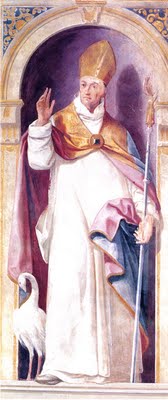
Saint Hugh of Lincoln

Today on the Carthusian calendar is the feast of Saint Hugh of Lincoln. Here’s an excerpt from Magna Vita Sancti Hugonis by Adam of Eynsham.

Hugh was a canon of Villarbenoit in Dauphine where he had entered as a youth. The potential qualities of saint and scholar were recognized in the boy and fostered by his tutor. With all his longing for holy orders Hugh shrank from promotion. The desire to be a priest was tempered by the sense of utter unworthiness.

At first sight Hugh was in love with the monastery of La Grande Chartreuse in its high solitude of the Dauphine Alps. It was here he would dwell, swiftly his mind was made up. The prior of Villarbenoit on the day he paid a visit to La Grande Chartreuse, taking Hugh with him for company, brought sorrow upon himself. For Hugh seeing the place was filled with rapture and an immediate resolve. Amazing and wonderful was this great monastery in the very heart of the mountains; amazing and wonderful this place, no other than the house of God and gate of heaven. It was the spirit of the place that thrilled him and held him captive.

On that first visit Hugh, young as he was, recognized the powerful charm of the Carthusian life. The solitude that is the essence of the Carthusian rule is tempered by the fact that the life is communal.

Youthful enthusiasm an excellent thing in itself is no evidence of religious vocation. Besides, it is written in the Carthusian constitutions that the severity of the Carthusian life must be set out plainly to all who seek admission. And then he was so young, this canon from the priory of Villarbenoit, and he looked delicate.

During that visit Hugh confided his hopes of becoming a Carthusian to others than the prior, and these so far from shaking their head at the presumption highly approved. They did more, they promised to back him up, urged him to stick to his purpose, did all they could to welcome him to the charterhouse.

Here was a horrible dilemma. That God had called him to the Carthusian life Hugh was convinced ; at the same time how could he resist the prayer of the dear old man who had been to him not only a foster-father but his superior, to whom he had promised obedience? His soul was torn and perplexed. His feelings counseled surrender. Hugh took the vow. While the prior lived he would not leave him.

And then having taken this oath to stay with the canons Hugh realized that it was a mistake, an oath that ought not to have been taken. He had acted in good faith; for the moment it had seemed that it was God's will he should stay at the priory. But it was clear he must not stay.
Once convinced that this oath taken under stress need not be kept, an oath which God did not desire to be kept, Hugh put his affairs at the priory in order and then without saying a word went quietly off to La Grande Chartreuse. He was welcomed joyfully and with the greatest kindness.

For sixteen years did Saint Hugh live at La Grande Chartreuse; the first ten in the uninterrupted solitude his soul desired. Prayer is the chief business: common prayer in the church, private prayer in the quiet of the hermit's cell. What finer life could Hugh, a man of prayer and of study, desire than this steady progress through the years?

With prayer went the training in obedience, poverty and chastity. La Grande Chartreuse trained men to be of strong character, of resolute will. The practice of obedience developed the talent to rule and command the obedience of others. In Hugh the daily exercise in humility produced a courage so robust and fearless that no room was left for subservience to the princes of this world.

The devil has his own methods for projecting evil, and unabashed by failure, aims to reduce the solitary to the mortifying humiliation of confessing partial surrender. In the case of Hugh the Carthusian the devil had no success at all. The torture of an imagination that day and night prompted the flesh to revolt, inviting a rush of wild rebellious feelings, threatening destruction to the health of the soul, had to be endured. Hugh did endure it; but held out stubbornly against any consent of the will to the pictures presented in the mind; refused flatly any recognition of the suggestions that surged so furiously within. They were not his, these vile intrusions of the devil; they did not belong to him, these loathsome pictures of the obscene. He would never receive them or own them. Hugh unflinching held to his course, answering temptation with prayer.

For Hugh came the end of the life of contemplation, of detachment from the world, the life of prayer and study he had set his heart upon. The business of the monastery was in his hands; the employment of servants on the monastery lands; the reception of visitors the procurator was guest master and would himself take guests to their appointed quarters.

Obedience does not come readily or easily to men like the twelfth-century lay brothers; but they rallied to Hugh, the new procurator. They said of him that he brought peace to their souls. Rare characters these lay brothers. Of iron will and gentleness of heart they walked with God and were without fear of man.

Hugh, later, by the order of the bishop of Grenoble became the prior of Witham. Hugh was now forty and prior of Witham, where as yet no priory stood, where everything remained to be done. He at once faced the situation and set about the work. The years of ordered discipline, the fine training in obedience left no room for fretful indulgence in regret or feeling of disappointment ; pride could not whisper a protest against the personal discomfiture, nor self-pity allow a sense of irritation at the depressing environment; for pride in Hugh, the Carthusian, there was none, and of self-pity he was ignorant. Banished from La Grande Chartreuse to this desolate spot in Somerset, the prior of Witham neither hesitated nor looked back.

Far too wise to seek the burden of responsibility shrinking in distress of mind every time it was forced upon him Hugh, once the burden was upon him, would never surrender the responsibility until authority sanctioned release. Good work prospered at Witham, the monastery walls rose steadily. The Carthusian life of prayer deepened with the years. In the few short hours given to sleep by the prior it was said by those who had business to come near him that they often heard him murmur Amen, amen while he slept, as though he were still at prayer.

Five years did Hugh rule Witham charterhouse as prior. The monastery was not completed when he was called to be bishop of Lincoln, but the greater part was built, and of stone that it might endure. He warned the monks against wooden structures that were liable to catch fire. And now, Anno Domini 1186, king Henry knew the man he must have for bishop of Lincoln his friend Dom Hugh, the Carthusian prior of Witham. Every year since the coming of Hugh to England the regard and affection of the king for his Carthusian friend had increased. On a rough crossing from Normandy to England when it seemed that the king and all his ships might be lost Henry had called on the mercy of God to heed the prayers of 'my Carthusian Hugh' in his cell at Witham or chanting the divine office with his brethren, and had come safely to land.

A hermit to rule! Dreadful thought! How could a monk trained to solitude manage the vast diocese of Lincoln? The canons were neither irreligious nor worldly beyond their fellows, but their hearts were dismayed and they trembled in mind at the prospect of this recluse, an austere Carthusian, a stranger to all their ways, coming into their midst. In the end a unanimous vote was given by the canons for the prior of Witham and messengers from the canons were sent to the priory with letters from the king and the archbishop announcing the result of the election, and calling on Hugh to present himself at court in order that a date might be fixed for consecration to the see of Lincoln.

On Saint Matthew's Day, September 21, 1186, was Saint Hugh consecrated, in the chapel of Saint Catherine in Westminster Abbey. All the vestments and ornaments that it was necessary for the bishop to put on, from the miter on his head to the sandals that covered his feet, were at Hugh's request of the simplest and plainest material.

Saint Hugh could command both respect and affection. His clergy loved him and revered him. His displeasure frightened people. Rarely was the bishop moved to anger, but when he saw one of his lay servants ill-treating a child the wrath of Saint Hugh exploded and he soundly cuffed that offending servant. Over and over again he had made it known to his attendants that he would not have children harshly treated or roughly handled, and since neither rebuke nor reprimand were effective, Saint Hugh came down heavily on the man who dared misuse one of God's little ones. In the diocese of Lincoln and in his own cathedral the bishop faced the fury of the anti-Jewish mob; in God's name he demanded an end to the wickedness, and would not be denied. Saint Hugh was most careful that the business of his court should be in every way worthily conducted; since that business was the administration of justice, the justice of God. Heavily the responsibilities of office bore upon him; and the cares and anxieties of his bishopric were at times so oppressive that more than once Saint Hugh begged the pope to let him return to the peace of the Carthusian cloister, to resign his See as other Carthusian bishops had been allowed to do. The Carthusian training and discipline prevailed. Modified the rule must be; the spirit of the sons of Saint Bruno was unquenched in the years when Hugh was bishop of Lincoln. There was no internal relaxation in the crowded hours. In his spare diet which required total abstinence from flesh-meat the only concession was an additional ration of fish. To others the bishop's hospitality supplied a generous table at all times. The hair shirt was retained, the white habit of the order was worn save when occasion demanded the official and ceremonial vestments. The bishop clung with devotion to the daily singing of the divine office.

Becoming ill, Saint Hugh, with fast unbroken, went to church at Dover and there said Mass. It was the last time he was to celebrate the holy mysteries, to offer the holy sacrifice. For two months more the flame of life flickered.

Saint Matthew's Day, September 21, was the anniversary of his consecration as a bishop and Saint Hugh decided that he must now receive the viaticum and be anointed with the oil of the sick. So after making a general confession of all his sins from boyhood the holy Eucharist was brought to him. St Hugh rose up from bed and knelt down to adore his Lord. The sacred Host was placed upon his lips. A short time after he was anointed. Strengthened by the Sacrament of Extreme Unction, Saint Hugh said cheerfully to his attendants: 'Physicians and diseases may now do their worst with me, for I care little for either of them. God Himself has come to me; I trusted to Him and I have received Him. I will hold Him and cleave to Him for ever.'

The clergy were saying Compline when the change in the bishop's countenance told them that the end was near. Saint Hugh made a sign and very tenderly his chaplains lifted the worn-out body and placed it on the ashes above the bare ground. Peacefully and quietly the bishop gave up his soul to God. It was just when they had reached Nunc Dimittis servum tuum Domine that he died, Thursday, November 16, A.D. 1200.

16 November 2010

Attend to a Continual and Internal Conversation

Seek to obtain by prayer whatever is necessary for you, saying: I fly unto You for help; teach me to do Your will, because You are my God. Do not leave me O my God, and do not depart from me; neither despise me Who are the God of my salvation. Incline Yourself to help me, O Lord, the God of my safety. Behold, I desire to return unto You, draw me after You, and never allow me again to be to be separated or withdrawn from You.

Hearken now to which I gave in commandment to one of My servants long ago, and endeavour also to fulfil it. I said unto him:

Use ever silence in thy tongue,
And have compunction in thy mind;
Be humble, courteous, meek, and mild,
If thou in Me wilt comfort find.

The same words in the same form do I speak unto you, having made it in the true measure of a verse, although you shall have less need of a measure to direct you when you come to this perfection. But I do not now deliver it unto you, as framed in measure to please your ears, but as a sovereign medicine to cure your soul. I have comprehended all those things which are necessary for you, briefly in this verse, that you may more easily retain them in your memory, and more often meditate upon them in your mind. For My will is, that you should altogether apply your endeavour to have a holy compunction for your sins, and that leaving all other business aside, you should only attend to a continual and internal conversation, and remaining weaned from all other pleasures, to be recollected into your own self, and so to continue always free from any distraction or perturbation whatsoever. Be silent in your tongue, and pure from filthiness in your heart. Be humble and meek, and remember to show yourself both courteous and gentle in all your behaviour.

~ Alloquia Iesu Christi ad Animam Fidelem, by Lanspergius ~

15 November 2010

Come to Me!

Prayer is the duty of every moment. ‘We ought always to pray’, said our Lord (Saint Luke 18:1). And what He said, He did: therein lay His great power. Action always accompanied His words, and corresponded with them.

We must pray always in order to be on our guard (cf. Saint Matthew 26:41). Our life both of body and soul, our natural and supernatural life, is like a fragile flower. We live surrounded by enemies. Ever since man rejected the light that was meant to show him the way (cf. Saint John 1:5), everything has become for us an obstacle and a danger: we live in the shadow of death (cf. Saint Luke 1.79 & Ps. 106.10).

Instead of pointing to the Creator and leading us to Him, things show only themselves, with the result that we stop at them. The devil, to whom we stupidly gave them when we gave him ourselves, speaks to us through their many voices; his shadow darkens their transparence. Beyond their attractive forms we no longer seek the beauty they reflect, but merely the pleasure and satisfaction they are able to offer us.

But the enemy is not only at our door, he is even more within us. And he is at our door, because he is within us. It is we who have invited him in. In turning towards him, we have turned the whole universe away from God. This is why the world is against us. It is inimical, hostile to us, and not without reason. Through the world and by it, we have let war loose within ourselves and in everything. This is only what one would expect, but it is terrible all the same.

What a profound definition of peace is Saint Augustine's! Above all, in these days, when the world is convulsed to its center, when men and things serve only to kill and destroy, how necessary it is to ponder well these words, the very sound of which is full of the calm they express: Peace is the tranquility of order. Order means that everything is in its proper place. God made men superior to all things (cf. Genesis 2.15), and all things turned to God as to their Source, to receive from Him their being moment by moment, and to thank Him and bless Him. That was the way God acted, and this is His order and His peace. It was this that fundamentally constituted the terrestrial Paradise, and will one day be the heavenly Paradise for those who have understood and taken up again this attitude (Genesis 3 passim).

I remember seeing once a frightened and hunted animal that had lost its way. It rushed through an open gate that led into a garden full of flowers, with what disastrous results can be imagined. This is an image, though a very imperfect one, of a soul when it allows the wild beast of the world to enter into it, ever since our first parents turned away from God and listened to the voice of the tempter. As a consequence, we live in a country occupied by the enemy, and it is our business to drive him out of it; to turn away from him and turn back to God, and so secure our liberty. And we have to do this without any armed or organized forces; with our faculties in disorder, our strength impaired, and surrounded by enemies on all sides or by those who are indifferent to our lot.

No greater helplessness could be imagined, had we not God. And that is why prayer is so necessary, and why our Lord had to tell us so insistently to pray, and to pray always. Hence, too, His saying which can seem so overwhelming: ‘Without Me, you can do nothing’ (Saint John 15.5), as well as His invitation so consoling and comforting: ‘Come to me’ (Saint Matthew 11.28).

Prayer is the soul's response to that invitation. It comes; it makes known its wretchedness, it pleads for help, for light for the mind and strength for the will. It asks for grace to bring its passions under the control of its higher will, and to submit that will to God, Who is order and peace. And God says to the soul: I am and always will be a Father: I love you and await your coming – Come!

~ Dom Augustin Guillerand ~

13 November 2010

A Loving Immersion into God

Today in Italy for the Carthusian Order is the feast of the Dedication of the Monastery Church of Serra San Bruno. At Matins the Gospel of Saint Luke (19:1-10) was proclaimed followed by a reflection from the fourteenth-century mystic, John Ruusbroec. Here is that reflection:

Usually one who has attained perfection of life and offers his entire life and all his activities to the praise and glory of God, directing his mind to God and loving Him above all things, will often be moved by the desire to see, to know, and to experience Who this Bridegroom is, this Christ Who for his sake became a human Being and laboured in love unto death, Who has forgiven him his sins and driven away the devil, Who has given him Himself and His grace and left him His sacraments, and Who has promised him His Kingdom and Himself as his eternal reward, and given bodily sustenance, interior consolation and sweetness, and countless other gifts according to each person’s need. When such a person considers all this, he is moved by an extremely strong desire to see and to know Christ his Bridegroom as He is in himself, for although he knows Christ in His works, this is not enough. He must therefore do as the publican Zacchaeus did when he desired to see Jesus as He was (cf. Saint Luke 19:1-10).

He must run ahead of the crowd, that is, all the multiplicity of the created order, since this makes a person short of stature, and so, unable to see God. He must then climb the tree of faith, which grows downward from above, since its roots are in the Godhead. This tree has twelve branches, which are the twelve articles of the Creed. The lowest of these speak of God’s Humanity and of those things which concern the salvation of our body and soul. The highest branches of this tree speak of the Godhead – of the Trinity of Persons and of the unity of the divine nature. A person must cling to this unity in the highest part of the tree, for it is there that Christ is to pass by with all His gifts. Here comes Jesus, Who sees this person and speaks to him in the light of glory, saying that according to His Divinity He is Infinite, incomprehensible inaccessible, and fathomless, transcending all created light and every finite concept.

This is the highest knowledge of God that a person can acquire in the active life, namely, that he acknowledge in the light of faith that God is incomprehensible and unknowable. In this light Christ says to this person’s desire, ‘Come down quickly, for I must stay at your house today’ (Saint Luke 19:5). This quick descent is nothing other than a desirous and loving immersion into the abyss of the Godhead, where no understanding which requires created light can reach. But where understanding remains without, desire and love enter within. When the soul thus inclines towards God with love and intent above all that it understands, then it abides in God and God in it.

When a soul ascends with desire above the multiplicity of the created order, above the activity of the senses and above all natural light, then it meets Christ in the light of faith; it becomes enlightened and confesses that God is unknowable and incomprehensible. When the soul inclines with desire toward this incomprehensible God, then it meets Christ and is filled with His gifts. When it loves and is at rest above all gifts, above itself, and above all creatures, then it abides in God and God in it. If you possess righteousness in charity, if you have laid down humility as a foundation, and built upon it a dwelling, namely, the virtues which here have been described, and if you have met Christ through faith and through directing your mind and your love to Him, then you abide in God and God in you.

12 November 2010

God Seeks Our Love Because of Our Unworthiness

Here’s more from the vault of Carthusian reflections. While it is seldom a topic of external conversation, at least interiorly the thought has crossed many hearts and minds as to the extent of sacrifice required to grow in intimacy with God, as well as how much suffering will our Lord permit in our life if we truly desire to follow in His Footsteps. For those who set aside time for God every day, such thoughts can become a daily Agony in the Garden. Our human weakness has many questions about the spiritual life, all stemming from our inability to surrender completely and unconditionally. This causes our life with God to lack an ‘ideal’, an inability to conceive a union that is very beautiful. Hope you enjoy these few paragraphs!

At last, I have found my ideal. Now I know where I want to go, and that I shall arrive at my goal. Hitherto, I have groped my way in the darkness; the difficulties I have encountered have wearied and discouraged me. Now I know, and henceforth nothing will hold me back. I will not rest until I have found God in the innermost depths of my heart: ‘I have found Him Who my soul loves; I held Him and I will not let Him go’ (Canticles 3:4). Love will give me wings, for ‘love is as strong as death’ (Canticles 8:6). Difficulties will no longer matter, for ‘I can do all things in Him Who strengthens me’ (Philippians 4:13).

If I glance over my past life and am truly sincere with myself, I will have to admit that so far my spiritual life has lacked an ideal, and that is the real reason I have made so little progress. I have failed to understand how deeply God loves and seeks souls – souls that will give themselves to Him so that He may give Himself to them. The degree of intimacy to which our Lord calls us will be achieved in the measure of the generosity of our response to grace. His love is without measure, and longs to give itself completely to souls. But souls are afraid, because of the consequence of that intimacy which calls for great sacrifices on our part.

In future, however, I shall be honest with myself. On the one hand, I know that God wants to take full and entire possession of my soul and that He has predestined me to be ‘conformable to the Image of His Son’ (Romans 8:29). He wants me to be His son by adoption. On the other hand, I know also that my unworthiness is no obstacle to His love. Who, indeed, could deem himself worthy? ‘If we say that we have no sin, we deceive ourselves’ (1 Saint John 1:8).

But there is much more than this. It is not in spite of our unworthiness that God seeks our love, but because of it: that He may reveal His glory in us. The more unworthy the material, the more is glory reflected on an artist who fashions a masterpiece out of it. It is this truth that our Lord tried to bring home to men in the parables of the prodigal son, and of the lost sheep. There is more joy in heaven, we are told, over one sinner doing penance than over all the just (cf. Saint Luke 15:7). If, then, I have made up my mind to persevere in my ideal, I must be continually acknowledging that, on the one hand, I am nothing and can do nothing of myself, but that, on the other hand, God is all: that He can do all things and wants to do all in me, so that I can make a complete oblation of my life to Him.