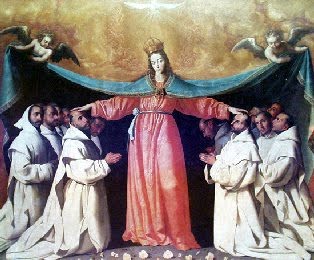
Today on the Traditional Calendar is the feast of Saint John of Matha (1169-1218), Founder of the Order of the Trinitarians. The painting is one of my favorite pieces in religious art. It is titled, “The Mass of Saint John of Matha” by Juan Carreño de Miranda. Tradition tells us that after his ordination to the priesthood, Saint John of Matha experienced a heavenly vision during his first Mass as a priest. This painting, which is at the Musée du Louvre in Paris, depicts that heavenly vision. Take notice of the adoration of Jesus in the Blessed Sacrament by the subjects of this painting. Click on the image for a larger look.
08 February 2010
Saint John of Matha
Today on the Traditional Calendar is the feast of Saint John of Matha (1169-1218), Founder of the Order of the Trinitarians. The painting is one of my favorite pieces in religious art. It is titled, “The Mass of Saint John of Matha” by Juan Carreño de Miranda. Tradition tells us that after his ordination to the priesthood, Saint John of Matha experienced a heavenly vision during his first Mass as a priest. This painting, which is at the Musée du Louvre in Paris, depicts that heavenly vision. Take notice of the adoration of Jesus in the Blessed Sacrament by the subjects of this painting. Click on the image for a larger look.
06 February 2010
Dominica Quinta per Annum
 First Reading, Isaiah 6:1-2a, 3-8
In all three Readings this weekend we see God's call on the lives of individuals: In this Reading, Isaiah; in the Second Reading, Paul; and in the Gospel, Peter. All three individuals imply unworthiness to such a calling. We all have that feeling, don't we? After all, who is worthy of Almighty God? At Mass, we communally express our unworthiness to receive Jesus in the Eucharist.
In our own lives we are sometimes in circumstances in which our worthiness is judged by others; and there are times when we sit in the judgment seat and determine the worthiness or unworthiness of others. And, of course, God probably finds our decision making process very amusing. In Scripture, for example, who would ever consider Peter as the ideal choice to be Chief Shepherd of Christ's Church; or who would've chosen Paul, enemy of Christ that he was, to be an apostle? Scripture has many examples of those called by God who seem unworthy by human standards.
In this Reading we find Isaiah being called by God to be a prophet. The opening verse places this Reading in the year that King Uzziah died. Whenever a story starts out like that, it's natural to assume that the death has already occurred. Saint Jerome, however, offers another possibility; he plants the seed in our minds that this could be Isaiah's first successful prediction and King Uzziah wasn't dead until after Isaiah's calling.
Isaiah saw the Lord seated on a high and lofty Throne. Isaiah's vision of the Lord was probably of the Son, not the Father, as Jesus Himself seems to suggest in John's Gospel when He refers to Himself as the fulfillment of the words spoken by Isaiah; and that Isaiah said those words because he saw the Lord's glory (cf. John 12:38-41).
Seraphim are the first of the nine orders of angels and they cried out: "Holy, holy, holy is the Lord of hosts!" The three-peat of the word "holy" has carried on through to our modern day liturgy. It may also be a clue to what is to be revealed much later, that God is One in three Persons: Father, Son, and Holy Spirit.
After Isaiah exclaims his unworthiness because of his unclean lips, one of the Seraphim touched his lips with an ember. An ember is a piece of coal which still has a slight glow to it when a fire is smoldering. The Latin version actually uses a word which translates as "coal" but the Septuagint translates as "carbuncle" which is a gem, when held up to sunlight, has the appearance of a glowing coal. Saint Basil interprets the ember to symbolize "the word of God" while Saint Jerome refers to it as "the spirit of prophecy".
In our own hearts and minds we may deem ourselves unworthy of God's call, but this Reading does show us that when God calls us, He will supply the graces necessary to fulfill that call. As loyal and willing servants of the Lord and each other, the abandonment of our will and our submission to God's will moves our hearts to cry out with Isaiah: "Here I am, send me!"
Second Reading, 1 Corinthians 15:1-11
Saint Paul refers to himself as "one born abnormally"; this is the humility of Paul speaking. The point he is making is that Christ appeared to him; and he judges himself to be the least deserving of such a gift. He doesn't consider himself to be in the same league as Cephas, who is Peter, and the other apostles because he admittedly persecuted the Church. And so, he refers to himself as an abnormal birth because of his self-proclaimed unworthiness and also, unlike the original twelve, Paul was called after Christ's death, Resurrection and Ascension.
He does say, however, that the grace of God working through him has made him toil harder than the others -- harder, not better -- and why not! It's not that Jesus favored Paul over the others or on the flip-side was punishing Paul by making him work harder because of his former days as a persecutor, but when we consider that Paul was indeed a persecutor of the Church, his extra-effort in laboring for Christ gives him much credibility especially when he is preaching the same message as the other apostles; or as Paul puts it, he is handing on that which he received.
Paul acknowledges that God's grace working through him has not been ineffective as he writes in this letter: "So we preach and so you believed." When God calls us and we respond affirmatively to that call, ineffectiveness is not an option; not because we're so pious that we're God's logical choice, but because no matter who we are or what we used to be by our own doing, God's grace is greater than all of that.
Gospel, Luke 5:1-11
Notice that Saint Luke mentions there are two boats; and Jesus got into the one belonging to Simon Peter. And what did Jesus do when He got into Simon's boat? He sat down and began to teach the crowds. This perhaps is a preview of the Chair of Peter or the office of the papacy. Something else to consider is the lake in which the Chair (boat) is on. The plain of Gennesaret, because of its beauty, has been called "the Paradise of Galilee"; and from the word "paradise" we get a sense of eternal beauty or heaven.
Water is a symbol of life and from it the faithful are baptized and given a new life in Christ, a life that is eternal. And so, from this Chair (boat) which rests on these waters of paradise the faithful receive the words of everlasting life.
When Jesus was finished speaking He instructed Simon by saying, "Put out into deep water and lower your nets for a catch." Simon responds by saying: "Master, we have worked hard all night and have caught nothing." After this exchange you can almost visualize Jesus giving Simon a divine stare as if to say: "Do you really doubt Me?" And Simon would then lower his head in embarrassment while mumbling the words, "But at your command I will lower the nets." And, of course, after following Jesus' instructions, so many fish were caught that the nets were tearing. For certain, a life committed to the Lord is a life of abundance.
After all of this, Simon, in astonishment over the amount of fish that were caught, must have felt compelled to somehow explain to his Lord why he questioned His instructions. What he did instead was fall at the knees of Jesus and declare his unworthiness by saying: "Depart from me, Lord, for I am a sinful man." And what does Simon get for his lack of faith and lack of trust in Jesus? -- Promoted to a fisher of men -- certainly not logical by human standards. Scripture does remind us, however, that God does not see as man sees because the Lord looks into the heart (cf. 1 Samuel 16:7). Perhaps what Jesus saw in Simon was a humble heart.
Simon, with divine assistance, caught an abundant and overflowing amount of fish; now, answering Jesus' call to be a fisher of men, he would be destined to find in his net innumerable souls.
05 February 2010
A Witness of Inexhaustible Eloquence
 Today the Church celebrates the feast of Saint Agatha who at a very young age devoted herself to God and resisted any temptations to have relationships with men. If fact, one high ranking official had her arrested because she resisted him. His hopes were that Agatha, a professed Christian in a time when Christianity was highly persecuted, would give in for fear of torture and death. But she held firmly to her faith and prayed: “Jesus Christ, Lord of all things, You see my heart, You know my desires. Possess alone all that I am. I am Your sheep, make me worthy to overcome the devil.” After being tortured the first time, she received from God a vision of Saint Peter who healed all her wounds. While enduring her final agonizing torture, before she died, she prayed: “Lord, my Creator, You have ever protected me from the cradle; You have taken me from the love of the world, and given me patience to suffer: receive now my soul.” Saint Agatha is often depicted in art as holding her breasts on a platter because it is said that one of the tortures administered to her was having her breasts cut off. At Matins, the Carthusians listened to a brief lesson about Saint Agatha written by Saint Methodius of Sicily. Here is what they heard.
The annual commemoration of Saint Agatha has brought us together; she is a martyr of ancient times who achieved renown in the early Church for her noble victory; she is also well known in modern times, for she continues to triumph through her divine miracles, with which she is daily crowned and beautifully adorned.
Agatha, who invites us to this religious feast is the bride of Christ, the virgin who wore the glow of a pure conscience and the crimson of the Lamb's Blood for her cosmetics. Again and again she meditated on the death of her Divine Lover.
Her robe is the mark of her faithful witness to Christ. It bears the indelible marks of His crimson Blood and also that of her virginity. Saint Agatha thus becomes a witness of inexhaustible eloquence for all generations.
Her robe is the mark of her faithful witness to Christ. It bears the indelible marks of His crimson Blood and also that of her virginity. Saint Agatha thus becomes a witness of inexhaustible eloquence for all generations.
Saint Agatha is truly good, coming forth from her Spouse in Whose goodness she shares, bearing the meaning of her name, Agatha, that is, “good,” given to us as a gift by God Himself, the source of all goodness.
What can be more beneficial than the Highest Good? And who could find something more worthy than a celebration with hymns of praise than Agatha? Agatha means “good” whose goodness fits both her name and her reality. Agatha, whose magnificent achievements delivers a glorious name while at the same time shows us the glorious deeds she accomplished. Agatha, who even by her name draws us, in order that everyone comes eagerly to meet her, and by her example teaches everyone to strive with her, without delay, towards the true “Good” Who is God alone.
04 February 2010
Inexpressible Equals Love
 After the great biblical event of the Transfiguration, Peter said to Jesus: “Master, it is good for us to be here: and let us make three tabernacles, one for You, and one for Moses; and one for Elijah: not knowing what he said.” It is the “not knowing what he said” part that the Carthusian, Nicholas Kempf (circa 1415-1497) focuses on here in this brief reflection from his “Expositiones Mysticæ Cantica Canticorum.” And as that title suggests, Nicholas Kempf explains Peter’s words by using the Old Testament book of the Song of Songs, a book which is often commented on in mystical theology. Here’s what Nicholas Kempf wrote, which has an underlying theme of encouraging us to make efforts to keep advancing closer to God until we make senseless statements and thus become joyfully reduced to silence.
“The Song of Songs is obscure. It indicates that these songs sung between God and a soul chosen as bride and mated and united to God in the human spirit’s chamber, united in the very image of God are utterly mysterious and completely inexpressible. Not even the bride herself is able to express what she has perceived. When hearts have been moved to jubilation of this sort, the things that result within the spirit cannot be put into conventional and customary words. Just as people drunk with wine lose the ability to talk in a normal fashion, so the bride drunk with sober intoxication speaks in a way intelligible not to anyone and everyone, but only to lovers loving in a similar way. So too, after tasting the sweetness of glory, Peter did not know what he was saying.”
03 February 2010
Suffer for My Sheep
 On this feast of Saint Blaise, his martyrdom was the theme for the Carthusians at Matins. Here is the short lesson from Saint Augustine that was proclaimed to the monks.
The Son of Man has come not to be served, but to serve, and to give His own life as a ransom for many (Matthew 20:28). Consider how the Lord served, and see what kind of servants He bids us to be. He gave His own life as a ransom for many; He ransomed us.
But who among us is able to ransom anyone? We have been redeemed through His Blood and we were ransomed from death by His death and His humility; and we who lay prostrate were raised up by His humiliation. And yet we, too, have a duty to contribute our meager offerings to His members, for we have become His members. He is the Head; we are the body.
In his letter, the apostle John exhorts us to follow the example of the Lord. Christ said: Whoever wishes to be the greater among you will be your servant, just as the Son of Man has come not to be served but to serve and to give His own life as ransom for many (Matthew 20:27-28). Thus this is the model that the apostle advises us to follow when he says: Christ laid down His life for us; so we, too, ought to lay down our lives for our brothers (1 John 3:16).
After His Resurrection our Lord asked: Peter, do you love me? And Peter replied: I do love You. The question and the answer were repeated three times. And each time the Lord added: Feed My sheep. In other words, if you want to show that you love Me, then feed My sheep. What will you give Me if you love Me, since you look for everything to come from Me? Now you know what you are to do if you love Me: Feed My sheep. Thus we have the same question and answer once, twice, three times. Do you love Me? I do love You. Feed My sheep. Three times Peter had denied in fear; three times he confessed out of love. By his replies and his profession of love, Peter condemned and wiped out his former fear. And so the Lord, after entrusting His sheep to him for the third time, immediately added: When you were a young man, you would gird yourself and go wherever you wished. But when you are old, another will gird you and take you where you do not wish to go. This He spoke signifying by what death he was about to glorify God (John 21:19). Thus He foretold Peter's own sufferings and crucifixion.
By this the Lord suggested that feed My sheep meant suffer for My sheep.
02 February 2010
Profoundly Adoring Christ's Mystery
 Today is the feast of the Presentation of the Lord. Jesus certainly desired to grasp firmly His Humanity by taking our humanity upon Himself and willfully accepting all the joys and sorrows associated with being human with the exception of committing sin, but nevertheless would take our sins upon Himself. His most holy Mother, attuned to the will of God in an extraordinary way, in a sense makes this decision for Jesus, since He is but an Infant. Speaking in terms of His Divine Person and Nature, circumcision is completely unnecessary for Him.
The exegete, Nicholas of Lyra suggests that circumcision is how Jesus manifests the reality of His Humanity. He also explains that as God, Jesus instituted circumcision, and therefore undergoing this process Himself, demonstrates His approval of it; and for our Lady and Saint Joseph, this was necessary according to the law which they knew so well. There is a mysterious level of humility here as well: as an Infant, He is incapable of making decisions, but as God he accepts upon Himself a procedure that is unnecessary – in other words, He makes Himself subject to His own law.
Our Blessed Lady also accepts upon herself the ritual of Purification, which for her is unnecessary. Saint Lawrence Justinian in a homily on the Purification points out that Mary was raised above the law by extraordinary grace, but her humility subjected her to it.
The poverty of the Holy Family is intimated in the Gospel account of the Presentation because turtledoves and pigeons was the offering of the economically poorer classes.
Simeon, thought to be a Jewish priest, witnesses first hand the embodiment of the consolation of Israel, the long-awaited Messiah. Simeon holds Jesus, given to him by His holy Mother. At Mass, a priest holds Him at the altar, given to him by the power of ordination and the words of Consecration through holy Mother Church.
In Simeon’s Nunc Dimittis, which the Church prays during her Night Prayer, there is an air of “it doesn’t get any better than this” in that prayer, considering that Simeon was now prepared to die. But it did get better than that. Simeon was able to hold Jesus and see Him; but through the Eucharist we get to receive Him into our souls. Still, there is much we can learn from Simeon’s disposition: if he was prepared to die at the sight of Jesus, how much joy should we have in receiving Him? If Simeon had the opportunity to stand in line waiting to receive Holy Communion, the wait would probably have made him antsy with anticipation. Are we? Jesus offers us Himself, our salvation, the Light and the glory of the Church. Isn’t this our highlight of the day or week?
It is fitting on this day to read at least some of the words of Saint Sophronius of Jerusalem. He was a seventh-century Patriarch of Jerusalem, but before his hierarchal appointment, he was a monk of great simplicity and he was also a theologian. He was born in Damascus and thus was of Arabian descent, but was often referred to as a Sophist because of his skills with the Greek language. Here is a piece of his homily which perhaps starts out by suggesting an interior dispostion in that we “run to Christ.”
We all run to Christ, we who sincerely and profoundly adore His mystery; we set out towards Him full of joy, carrying lighted candles, as a symbol of His divine splendor.
Thanks to Him all creation is radiant; in truth it is inundated by an eternal light which dissipates the shadows of evil and makes the whole universe radiant with the brilliance of His eternal light. But let these lighted candles be especially the symbol of the eternal splendor with which we wish to prepare ourselves for our meeting with Christ. Indeed, just as His Mother, the most pure Virgin, carried Him in her arms, Who is the true light, and showed Him to all who find themselves in darkness, so may we also, who hold in our hands this light that is visible to all, and who are illuminated by its shining, hasten to go to meet Him, Who is the true light.
The Dayspring from on High has visited us and given light to those who lived in darkness. This, then, is our feast, and we join in procession with lighted candles to reveal the light that has shone upon us and the glory that is yet to come to us through Him. The light that enlightens every man who comes into the world, has come. All together we come to Christ, to let ourselves be clothed with His splendor and, together with the old man Simeon, welcome Him, the eternal living light. With him we exult with joy and sing a hymn of thanksgiving to God, Father of light, Who sent us the true light to lead us out of darkness and make us luminous.
Through Simeon’s eyes we too have seen the salvation of God which He prepared for all the nations and revealed as the glory of the new Israel, which is ourselves. As Simeon was released from the bonds of this life when he had seen Christ, so we too were at once freed from our old state of sinfulness.
By faith we too embraced Christ, the salvation of God the Father, as He came to us from Bethlehem. Gentiles before, we have now become the people of God. Our eyes have seen God Incarnate, and because we have seen Him present among us and have mentally received Him into our arms, we are called the new Israel. Never shall we forget this presence; every year we keep a feast in His honor.
01 February 2010
Heaven on Earth
 The Carthusian, Guiges, using as examples the lives of Saint John the Baptist with his unceasing prayer in solitude in the desert and our Lord Himself Who would go into the mountains to pray alone, said: “There is nothing better one can choose in life than solitude with the soft sweetness of the Psalms, the application to reading, the fervor of prayer, the depth of meditation, the transport of contemplation, and the baptism of tears.”
Generally as a rule, the Carthusians do not accept retreatants into the Charterhouse, except those who feel they may have a Carthusian vocation. But whether it was those who were testing a vocation or those in which the rule was excepted, visitors to the Charterhouse have made some interesting proclamations concerning their time spent there. Borrowing from the book, “Halfway to Heaven” by Robin Bruce Lockhart, here are some of those statements which were found in the visitors’ book at Saint Hugh’s Charterhouse, Parkminster:
“I would love to live and die here.”
“Precious peace and silence.”
“I have found here that peace which the world cannot give.”
“Thank God for such centers of prayer. He lives in a special way in the community.”
“Truly a place of healing. Thank you Fathers and Brothers for a lovely encounter with Christ.”
“This heaven on earth.”
“Please God here I experienced the beginning of the exquisite taste of peace.”
“Thy will be done. . . and here it is.”
“Now I know that I am loved, before I just hoped.”
“A milestone in my life. Much is said in silence.”
“Here I met the happiest people in the world.”
“An oasis in a crazy world.”
“The highlight of my life, such as may not recur.”
And the phrase which was found most often in the visitors’ book was: “An unforgettable experience.”
And from an eighteen year old who was hoping to enter the Order as a novice wrote: “Please God that in two years I may enter this House and never come out of it again.”
The second Superior General of the French Congregation of the Oratory, Père Charles de Condren (1588-1641), wrote: “The dwelling amidst the mountains of La Grande Chartreuse is not an abode for the people of the world. It needs a being who is all soul to live in such a spot. But when this paradise has been reached, there is nothing more to hope for on earth. You may come from where you will in the world, even from its holiest shrines, but once arrived at this House of God, the gate of Heaven, you must become a saint or you never will become one anywhere.”
Subscribe to:
Posts (Atom)