11 August 2011

Look into that Mirror Daily

Today, the Church celebrates the Feast of Saint Clare of Assisi. It was Saint Francis of Assisi who saw in Clare something special, extraordinary – a soul who would be a great witness to the Gospel way of life. She is the co-foundress of the Order of Poor Clares.

Pope Gregory IX came to Assisi in 1228 for the purpose of canonizing Francis, but also made a stop at San Damiano to try and convince Clare to ease up on the strictness of her life of poverty. Even if it was a vow that led to such rigidity, Pope Gregory IX was willing to absolve her from it. But Clare resisted and said to the pope: “Holy Father, I crave for absolution of my sins, but I do not wish to be absolved from the obligation of following Jesus Christ.” This impressed the Holy Father and in September of 1228 he granted her the Papal Bull, Privilegium Paupertatis (Privilege of Poverty). Here is that text:

“Gregory Bishop Servant of the Servants of God.
To our beloved daughters in Christ Clare and the other handmaids of Christ dwelling together at the Church of San Damiano in the Diocese of Assisi. Health and Apostolic benediction. It is evident that the desire of consecrating yourselves to God alone has led you to abandon every wish for temporal things. Wherefore, after having sold all your goods and having distributed them among the poor, you propose to have absolutely no possessions, in order to follow in all things the example of Him Who became poor and Who is the way, the truth, and the life. Neither does the want of necessary things deter you from such a proposal, for the left arm of your Celestial Spouse is beneath your head to sustain the infirmity of your body, which, according to the order of charity, you have subjected to the law of the spirit. Finally, He who feeds the birds of the air and Who gives the lilies of the field their raiment and their nourishment, will not leave you in want of clothing or of food until He shall come Himself to minister to you in eternity when, namely, the right Hand of His consolations shall embrace you in the plenitude of the Beatific Vision. Since, therefore, you have asked for it, we confirm by Apostolic favor your resolution of the loftiest poverty and by the authority of these present letters grant that you may not be constrained by anyone to receive possessions. To no one, therefore, be it allowed to infringe upon this page of our concession or to oppose it with rash temerity. But if anyone shall presume to attempt this, be it known to him that he shall incur the wrath of Almighty God and his Blessed Apostles, Peter and Paul.
Given at Perugia on the fifteenth of the Kalends of October in the second year of our Pontificate.”

Since the establishment of Holy Mother Church by our Lord and Savior Jesus Christ, there has never been a so-called “golden age” of the Church. She has always had her problems and challenges. Perhaps the battle that has always existed is, “the way of Christ versus the way of the world.” Secularization is a huge challenge for today’s Christian. The weaknesses of our nature is prone to surrendering to that which is constantly before us; and in our modern day culture, that is secularism. Saint Clare teaches us by her own example that through the grace of Almighty God, we can live for Christ alone and overcome the enemy of our times.

Clare had a great love for the Blessed Sacrament. In her letter to Blessed Agnes of Prague, Clare writes about how happy it is “to cleave with one’s heart to Him Whose beauty all the heavenly hosts behold forever, Whose love inflames our love.” Clare adds that contemplating Jesus “makes us glow with happiness.” He is “the Mirror without spot.” Then she instructs Agnes and us by urging us to “look into that Mirror daily.” If we are to conquer our weaknesses and live for God, daily prayer, and most especially spending time with the Blessed Sacrament are a must.

In sacred art, Saint Clare is often depicted with a ciborium. This not only exhibits Clare’s love for the Eucharist but also proclaims the story in which soldiers scaled the walls of San Damiano during the night. Clare rose from her bed, went to the chapel and grabbed the ciborium, taking our Eucharistic Lord to an open window. The soldiers had already placed a ladder beneath that window to climb and enter through it. Clare raised the Blessed Sacrament which caused the soldiers on the ladder to fall while the rest ran away. This is the power of that “Mirror” which Clare exhorts us to look into daily.

Sancta Clara, ora pro nobis!

10 August 2011

Desiring to be a holocaust for Jesus

Deacons, today we pray especially for you on this, the Feast of Saint Laurence, deacon and martyr.

The word “deacon” is derived from the Greek word, “diakonia” which means “care” or “service.”

Saint Ambrose describes a deacon as having three characteristics:

First, a deacon having been sacramentally constituted in the service of self-giving, lives his diaconal ministry giving witness to Christ in martyrdom, the service of charity by acceptance of that greater love which is martyrdom.

Second, in virtue of the link which binds him to the bishop, the deacon lives ecclesial communion by specific service to the bishop, beginning with the Eucharist and in reference to the Eucharist.

Third, in virtue of the Sacrament, the deacon devotes himself fully to the service of a constituent charity and not merely to a human or social fellowship, and thus manifests the most characteristic element of the diakonia.

In De Officiis, Saint Ambrose describes a very heartfelt but intense moment between Laurence and Sixtus II, the pope who was being led to execution. Here is the exchange according to the Ambrosian text:

Saint Laurence wept when he saw his bishop, Sixtus, led out to his martyrdom. He wept not because he was being let out to die but because he would survive Sixtus. He cried out to him in a loud voice: “Where are you going Father, without your son? Where do you hasten to, holy bishop, without your deacon? You cannot offer sacrifice without a minister. Father, are you displeased with something in me? Do you think me unworthy? Show us a sign that you have found a worthy minister. Do you not wish that he to whom you gave the Lord's Blood and with whom you have shared the sacred mysteries should spill his own blood with you? Beware that in your praise your own judgment should not falter. Despise the pupil and shame the Master. Do not forget that great and famous men are victorious more in the deeds of their disciples than in their own. Abraham made sacrifice of his own son, Peter instead sent Stephen. Father, show us your own strength in your sons; sacrifice him whom you have raised, to attain eternal reward in that glorious company, secure in your judgment.”

Sixtus replied: “I will not leave you, I will not abandon you my son. More difficult trials are kept for you. A shorter race is set for us who are older. For you who are young a more glorious triumph over tyranny is reserved. Soon, you will see, cry no more, after three days you will follow me. It is fitting that such an interval should be set between bishop and Levite. It would not have been fitting for you to die under the guidance of a martyr, as though you needed help from him. Why do you want to share in my martyrdom? I leave its entire inheritance to you. Why do you need me present? The weak pupil precedes the master, the strong, who have no further need of instruction, follow and conquer without him. Thus Elijah left Elisha. I entrust the success of my strength to you.”

Saint Ambrose continues his text by telling us that Laurence’s longing for martyrdom was due to his desire to be a holocaust for Jesus Christ.

It has been said that Lawrence was roasted to death on a grid-iron three days after the death of Sixtus.

Sancte Laurenti, ora pro nobis!

09 August 2011

Dwelling in the Shelter of the Rays

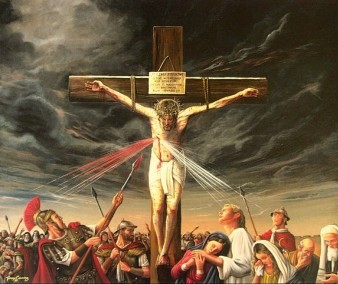
“One evening as I entered my cell, I saw the Lord Jesus exposed in the Monstrance under the open sky, as it seemed. At the Feet of Jesus I saw my Confessor, and behind him a great number of the highest ranking ecclesiastics, clothed in vestments the like of which I had never seen except in this vision; and behind them, groups of religious from various Orders; and further still I saw enormous crowds of people, which extended far beyond my vision. I saw the two rays coming out from the Host, as in the image, closely united but not intermingled; and they passed through the hands of my Confessor, and then through the hands of the clergy and from their hands to the people, and then they returned to the Host.”

These words are from the Diary of Saint Maria Faustina Kowalska. It would seem to be a marvelous vision of Christ’s Church in Eucharistic Adoration.

Later she wrote: “When I was in church waiting for Confession, I saw the same rays issuing from the Monstrance and spreading throughout the church. This lasted all through the service.” This “service” which she mentions was Eucharistic Adoration followed by Benediction. Saint Faustina continued: “After the Benediction, the rays shone out to both sides and returned again to the Monstrance. Their appearance was bright and transparent like crystal.”

These “rays” were explained by our Lord to Saint Faustina: “The two rays denote Blood and Water. The pale ray stands for the Water which makes souls righteous.” This of course is the Sacrament of Baptism. Our Lord continued: “The red ray stands for the Blood which is the life of souls.” This is the Sacrament of the Eucharist.

Most fascinating about these rays is Saint Faustina’s description of them appearing “like crystal.” Saint John the Evangelist’s vision would seem to concur: “And he showed me a river of water of life, clear as crystal, proceeding from the Throne of God, and of the Lamb” (Revelation 22:1). This would appear to be synonymous with the pale ray of Water. Saint John the Evangelist also wrote: “He showed me the holy city of Jerusalem, coming down out of heaven from God, having the glory of God, and the light thereof was like to a precious stone, as to the jasper stone even as crystal” (Revelation 21:10-11). The color of jasper is red, which is harmonious with the Blood of Christ or the Eucharist.

The mercy of Jesus, therefore, flows from His Eucharistic Heart, but also His mercy is to be received by means of the holy city of Jerusalem, signifying the Church, the New Jerusalem. And once again referring to our Savior’s Eucharistic Heart, Saint Faustina also saw these rays during Vespers with a Eucharistic procession for the Sacred Heart of Jesus.

Jesus spoke to Saint Faustina about three o’clock being the hour of mercy. One of the options that our Lord suggests at this “hour of grace for the whole world” is to be in the chapel adoring the Blessed Sacrament.

The rays of mercy flow from the Heart of Jesus in Eucharistic Adoration. Shouldn’t we adore Jesus in the Blessed Sacrament as often as possible? Jesus said to Saint Faustina: “These rays shield souls from the wrath of My Father. Happy is the one who will dwell in their shelter.”

06 August 2011

Wholly Dedicated to Contemplation

Dear readers of Secret Harbour - Portus Secretioris, in remembrance of today’s Feast please offer a prayer for the monks of the Carthusian Charterhouse of the Transfiguration in Vermont. Thank you! Here’s a brief meditation on the Transfiguration provided by the Carthusians:

"Jesus took with Him Peter and James and John, and brought them up to a high mountain by themselves. And He was transfigured before them; and His garments became radiant and exceedingly white, as no launderer on earth can whiten them" (Mark, 9:2-3).

The Transfiguration of the Lord contains all the constitutive elements of Christian contemplation.

Jesus climbs up a mountain to pray, and He takes Peter, James and John with Him.

Suddenly, as He is praying, He is transfigured. (Matthew 17:2; Luke 9:29; Mark 9:2). Before Jesus looked like a man, now He is manifested as God-Man. His Face is still human, but now it now reflects His divinity. His clothes shed intense pure light. Peter, James and John do not see this with their ordinary vision: only their illumined eyes can see the resplendent Glory of the Father (Luke 9:32).

They are awe-struck. Then a cloud comes over and a Voice declares: "This is My Son, My Chosen One; listen to Him." With these words, the Transfiguration ends and they go down the mountain again.

The Transfiguration of the Lord allows us to contemplate, not only the Mystery of Jesus, but also our own mystery. Prayer and contemplation, lived in pure faith during this life, are the beginning of our own Transfiguration.

The Carthusian monk is wholly dedicated to contemplation: sustained by the scriptures, and by the grace of the Holy Spirit led into the depths of his heart, the monk experiences in some sort the incomparable Beauty of the Light of God radiating from Christ.

"Beloved, we now are children of God, and it has not appeared as yet what we shall be. We know that, when He appears, we shall be like Him, because we shall see Him just as He is" (1 John 3:2).

Purifying Our Spiritual Eyes of Worldly Thoughts

God manifests Himself upon the Mount, on the one hand coming down from His heights, and on the other, raising us up from the depths of abasement, since the Transcendent One takes on mortal nature. Certainly, such a manifest appearance by far transcends the utmost limits of the mind’s grasp, as effectualized by the power of the Divine Spirit.

Thus, the Light of the Transfiguration of the Lord is not something that comes to be and then vanishes, nor is it subject to the sensory faculties, although it was contemplated by corporeal eyes for a short while upon an inconsequential mountaintop. But the initiates of the Mystery, the disciples of the Lord at this time passed beyond mere flesh into spirit through a transformation of their senses, effectualized within them by the Spirit, and in such a way that they beheld what, and to what extent, the Divine Spirit had wrought blessedness in them to behold the Ineffable Light.

Those not grasping this point have conjectured that the chosen from among the Apostles beheld the Light of the Transfiguration of the Lord by a sensual and creaturely faculty, and through this they attempt to reduce to a creaturely level not only this Light, the Kingdom and the Glory of God, but also the Power of the Divine Spirit, through Whom it is meet for Divine Mysteries to be revealed. In all likelihood, such persons have not heeded the words of the Apostle Paul: “Eye has not seen, nor ear heard, nor has it entered into the heart of man, what things God has prepared for those who love Him. But to us God has revealed them through His Spirit. For the Spirit searches all things, even the deep things of God” (1 Corinthians 2:9-10).

So, with the onset of the eighth day, the Lord, taking Peter, James and John, went up on the Mount to pray. He always prayed alone, withdrawing from everyone, even from the Apostles themselves. In our instance right here and now, having taken only these three, the Lord led them up onto a high mountain by themselves and was transfigured before them, that is to say, before their very eyes.

“What does it mean to say: He was transfigured?” asks the Golden-Mouthed Theologian (Saint John Chrysostom). He answers this by saying: “It revealed something of His Divinity to them, as much and insofar as they were able to apprehend it, and it showed the indwelling of God within Him.” The Evangelist Luke says: “And as He prayed, His countenance was altered” (Saint Luke 9:29); and from the Evangelist Matthew we read: “And His Face shone as the sun” (Saint Matthew 17:2). But the Evangelist said this, not in the context that this Light be thought of as subsistent for the senses. Rather, it is to show that Christ-God, for those living and contemplating by the Spirit, is the same as the sun is for those living in the flesh and contemplating by the senses. Therefore, some other Light for the knowing the Divinity is not necessary for those who are enriched by Divine gifts.

That same Inscrutable Light shone and was mysteriously manifest to the Apostles and the foremost of the Prophets at that moment, when the Lord was praying. This shows that what brought forth this blessed sight was prayer, and that the radiance occured and was manifest by uniting the mind with God, and that it is granted to all who, with constant exercise in efforts of virtue and prayer, strive with their mind towards God. True beauty, essentially, can be contemplated only with a purified mind. To gaze upon its luminance assumes a sort of participation in it, as though some bright ray etches itself upon the face.

We believe that at the Transfiguration He manifested not some other sort of light, but only that which was concealed beneath His fleshly exterior. This Light was the Light of the Divine Nature, and as such, it was Uncreated and Divine. It was to show His disciples that which He already was, opening their eyes and bringing them from blindness to sight. For do you not see that eyes that can perceive natural things would be blind to this Light?

Thus, this Light is not a light of the senses, and those contemplating it do not simply see with sensual eyes, but rather they are changed by the power of the Divine Spirit. They were transformed, and only in this way did they see the transformation taking place amidst the very assumption of our perishability, with the deification through union with the Word of God in place of this.

Let us, considering the Mystery of the Transfiguration of the Lord, strive to be illumined by this Light ourselves and encourage in ourselves love and striving towards the Unfading Glory and Beauty, purifying our spiritual eyes of worldly thoughts and refraining from perishable and quickly passing delights and beauty which darken the garb of the soul.

- Saint Gregory Palamas -

04 August 2011

Quia viderunt oculi mei salutare Tuum

The Church prays the Nunc Dimittis daily in her Night Prayer or Compline. They are the words of Simeon as he held the Christ Child in his arms at the Presentation in the Temple, the fourth Joyful Mystery of the Holy Rosary:

“Now Thou dost dismiss Thy servant, O Lord, according to Thy word in peace;
Because my eyes have seen Thy salvation,
Which Thou hast prepared before the face of all peoples;
A light to the revelation of the Gentiles and the glory Thy people Israel.”

Saint Ephraem, in his “Homily on Our Lord,” tells us that Simeon is a priest. Our Blessed Mother, perhaps quite prophetically, passes our Lord from her hands into the hands of a priest. And certainly one can sense the overwhelming immensity of Simeon’s emotions as he holds the Saviour of the world in his hands. This is far too mysterious for the human intellect to fully grasp. To paraphrase Simeon, what he’s saying is: “Okay Lord, take me now, for what I am doing at this moment, nothing else in this life will surpass it.”

At each and every Holy Mass the priest has the incomprehensible privilege of holding the Saviour of the world in his hands on the altar. Please God, may your priests never take for granted the enormity of what they do on the altar!

Today is the Feast of Saint Jean Marie Vianney; he certainly was never nonchalant about the power given to him as a priest. The Curé d’Ars shed many tears of joy during Mass especially when he was holding our Eucharistic Lord in his hands during his thanksgivings and often long adorations. He would say: “To celebrate Mass one ought to be a seraph! I hold our Lord in my hands. I move Him to the right, and He stays there, to the left, and He stays there! To know what the Mass is would be to die. Only in heaven shall we understand the happiness of saying Mass! Alas, my God, how much a priest is to be pitied when he does this as an ordinary thing!”

It was on a Christmas night at Mass as he held the Sacred Host in his hands above the Chalice, and tears were flowing from his eyes when the Holy Curé prayed in his heart: “My God, if I knew that I was to be damned, now that I hold Thee, I would not let Thee go again.”

And how about those of us in the laity? What should our disposition be as the priest holds our Lord in his hands? We will never appreciate our Lord in the Blessed Sacrament as “un bain d’amour” (a bath of love), to quote Saint Jean Marie Vianney, until we establish a daily prayer life. The Holy Curé d’Ars referred to prayer as man’s noble task. As servants of God, prayer is not an option, but an absolute necessity. “With God all things are possible” (Saint Matthew 19:26). Saint Jean Marie gives us something to think about: “Saint Catherine of Genoa so hungered for this heavenly Bread that she could not see it in the priest’s hands without feeling as though she were dying of love, so great was her desire to possess it, and she would cry: 'Ah, Lord come into me! My God, come to me, I can bear it no longer! Ah, my God, come, if it please Thee, into my inmost heart; no, my God, I can bear it no longer. Thou art my whole joy, my whole happiness, and the only Food of my soul.’ Happy the Christian who comprehends this. If we understood it even a little, we could only desire life so far as it meant the happiness of making Jesus Christ our daily Bread.”

Do you think anyone would ever consider skipping Mass if they possessed the same love for the Blessed Sacrament as that of Saints Jean Marie Vianney and Catherine of Genoa?

01 August 2011

Performing on Earth the Office of the Citizens of Heaven

Here is a reflection on the Divine Office by Saint Alphonsus Liguori, whose feast the Church celebrates today:

By the Divine Office God is honored, the fury of the enemy is repelled, and the divine mercies are obtained for sinners. But to attain these ends it is necessary to recite the Office in a proper manner: it is necessary to say it carefully and devoutly.

Carefully, by pronouncing the words distinctly; devoutly, that is, with attention, as Cassian teaches: “Let that be considered in the heart which is uttered by the lips.”

“How,” asks Saint Cyprian, “can you expect that God will hear you when you do not hear yourself?” Prayer made with attention is the odoriferous incense that is most agreeable to God, and obtains treasures of grace; but prayer made with voluntary distraction is a fetid smoke that provokes the divine wrath, and merits chastisement. Hence, while we recite the Office, the devil labors strenuously to make us say it with distractions and defects. We should, then, take all possible care to recite it in a proper manner.

It is necessary to enliven our faith, and to consider that in reciting the Divine Office we unite with the angels in praising God. “We begin here upon earth the Office of the inhabitants of heaven,” says Tertullian. We then perform on earth the Office of the citizens of heaven, who unceasingly praise God, and shall praise Him for an eternity. “Hence,” as Saint John Chrysostom remarks, “before we enter the church or take up the breviary we must leave at the door and dismiss all thoughts of the world.”

In reciting the Divine Office we must take care that our affections accompany the sentiments contained in what we read. It is necessary, says Saint Augustine “we must pray when the Psalmist prays, sigh when he sighs, hope when he hopes.” It is useful to renew our attention from time to time; for example, at the beginning of every psalm. We must be careful not to give occasion to mental distractions. How can he who recites the Office in a public place, or in the midst of persons who are jesting and amusing themselves, how, I ask, can he say it with piety and devotion?

Oh! what treasures do they lay up who daily recite the Divine Office with devout attention! Saint John Chrysostom says that they are filled with the Holy Spirit. But, on the other hand, they who say it negligently lose great merits, and have to render a great account to God.